Industrial Display Terminal Structure Design Analysis: Senke Body Craftsmanship Design Concept
Product knowledge 2026-05-08
In the industrial automation system, an industrial display is not merely a simple display screen. The overall structure craftsmanship, shape layout, sealing design, and installation adaptation directly determine the usage period and operating condition of the equipment in the field. After years of process accumulation in the Chinese industrial display industry, the body structure design has formed a mature idea that suits local working conditions. It no longer simply follows the design logic of civilian display equipment, but focuses on special optimization for industrial usage environments.
Ordinary household or commercial displays mainly focus on lightweight appearance and placement at home, without considering complex factors such as dust, moisture, vibration, and temperature differences. However, industrial scene environments are complex, including production workshops, equipment cabinets, monitoring stations, and control machine rooms. These places have actual requirements for the body’s sealing, structural firmness, and installation adaptability. This also drives industrial display structure design towards specialization, practicality, and scene-based.
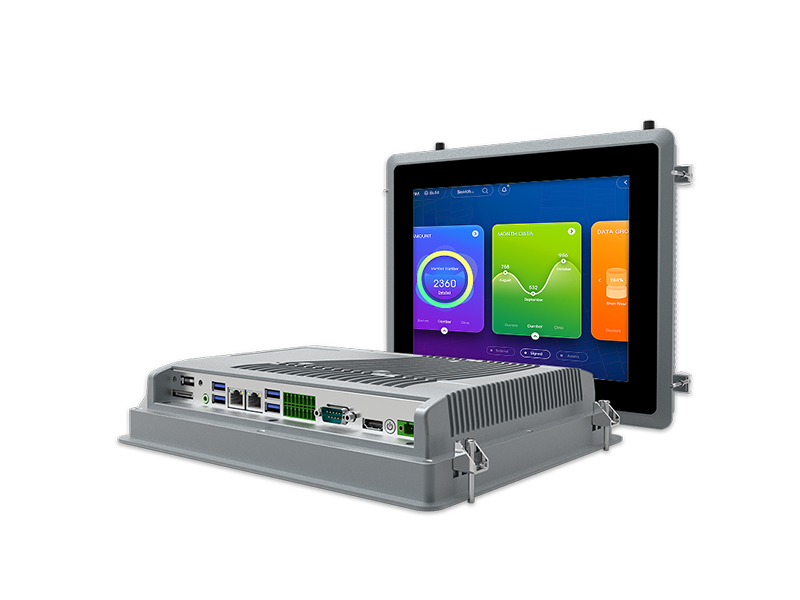
The main components of industrial display structure design include shell material, overall sealing, internal reinforcement, heat dissipation layout, and installation adaptation. The shell material needs to have corrosion resistance, not be prone to deformation, and be resistant to bumps. It should be able to adapt to workshop air, minor oil stains, and daily touch and friction over a long period. The overall sealing needs to block dust and moisture from entering the body, protecting the core components such as the panel, motherboard, and circuits. Internal reinforcement is aimed at equipment transportation and mechanical vibration scenarios to avoid component loosening and interface disconnection. The heat dissipation layout follows the logic of industrial low-power long-term operation, adapting to the need for long-term. The installation structure should be compatible with embedded, wall-mounted, rack-mounted, and desktop installation methods.
Senke focuses on the research and production of industrial display terminals and always takes the actual industrial site conditions as the starting point in body structure design. It does not deliberately pursue flashy appearance and prioritizes practicality, stability, and durability in the design. In shell material selection, metal materials suitable for long-term use in industrial environments are chosen. The overall forming process is regular, and surface treatment takes into account scratch resistance and corrosion resistance, making it unlikely to cause paint peeling, deformation, or rust over a long period of use, suitable for various workshop regular environments.
The overall sealing process is the key part of Senke’s structure design. The body connection points adopt a matching sealing process, combined with special sealing rubber strips, with no extra exposed holes on the entire machine, forming a closed structure. This design can effectively prevent dust floating particles, damp water vapor, and minor oil stains from invading the internal body, reducing common faults such as circuit oxidation, contact dust accumulation, and component short circuits, and is suitable for long-term use in environments with high dust and humidity such as mechanical processing, food production, and chemical support.
For the common vibration environment in industrial sites, Senke industrial display internally strengthens components, with display panels, main control boards, interface modules, and circuit layouts using fixed limit structures to reduce loosening and offset during transportation, machine operation, and production line vibrations, reducing screen flickering, touch control failure, and signal interruption problems, and enhancing the overall anti-vibration ability.
In the heat dissipation structure design, relying on low-power hardware solutions, combined with natural heat dissipation layout of the body, without forced fan hole design, it not only maintains the closed dust-proof effect of the entire machine but also meets the heat dissipation requirements for long-term continuous operation, avoiding dust accumulation causing poor heat dissipation and component overheating aging, and conforming to the 7×24-hour duty operation mode of industrial use.
In terms of installation structure, the product is reserved standard installation holes and adapter slots, taking into account embedded internal installation, wall-mounted installation, standard cabinet mounting, and open equipment mounting, with hole specifications matching industry standards, facilitating on-site construction installation, later dismantling and maintenance, without the need for additional modification of cabinets or supports, reducing the installation cost and time cost of the project. As the integration degree of industrial equipment continues to increase, more and more complete equipment requires embedded display terminals, which puts forward higher requirements for the width of the industrial display frame, the thickness of the body, and the adhesion degree. Senke follows the trend of equipment integration, optimizes the narrow frame structure design, reduces the redundant space of the body, and adapts to the installation requirements of compact equipment cabinets while maintaining the structural strength and protection ability.
Overall, the core competitiveness of industrial displays often lies in the structural and process details. External parameters are only basic references. The body design, sealing process, reinforcement layout, and installation adaptation are the key factors determining whether the equipment can operate stably for a long time. The Chinese industrial display industry has continuously accumulated and optimized in the structural design aspect, and is more in line with the actual working conditions of various industrial sites in China. Senke adheres to practical craftsmanship as the core, refines product quality from structural details, uses mature body design concepts to adapt to the long-term usage needs of various industrial scenarios, and provides reliable display terminal hardware support for industrial equipment matching and the implementation of automation projects.