In the era of Industry 4.0, how do touchscreen computers become the nerve center of intelligent factories?
Product knowledge 2026-04-30
The advent of Industry 4.0 has driven industrial production towards intelligent, automated, and networked directions, making intelligent factories a core trend in industrial development. Intelligent factories focus on data as the core, achieving intelligent control of the production process, collaborative operation of equipment, and optimized allocation of resources. As the core device for industrial human-computer interaction, touchscreen computers, with their advantages of visualization, convenience, and integration, gradually become the nerve center of intelligent factories, connecting various links such as production, equipment, personnel, and data, providing support for the efficient operation of intelligent factories.
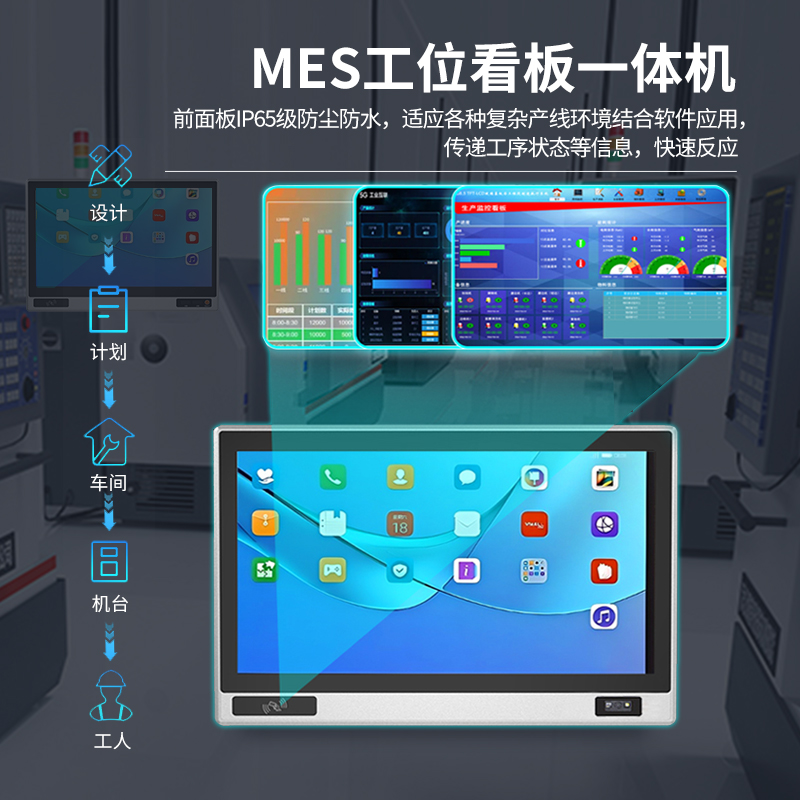
The core demand of intelligent factories is to achieve full control and intelligent decision-making of the production process. Touchscreen computers, as the core carrier of data interaction, undertake important functions such as data collection, data display, instruction input, and decision transmission, running through all aspects of intelligent factories. In the production control, touchscreen computers can collect real-time data on equipment operation parameters, production progress, and product quality, presenting it in a visualized manner to operators and managers, enabling them to promptly grasp production conditions and identify problems in the production process, adjust production plans, and ensure production efficiency and product quality.
In the equipment collaboration, various production equipment, sensors, robots in intelligent factories need to achieve collaborative operation. Touchscreen computers, as the bridge connecting various devices, can realize data sharing and instruction transmission between devices. Operators can remotely control various devices through touchscreen computers, adjust device parameters, and achieve collaborative operations, improving the automation level of production. For example, in an intelligent manufacturing production line, touchscreen computers can connect robots, conveyors, and inspection equipment to achieve automated control of the production process, reducing human intervention and improving production efficiency.
In the data processing and decision-making, touchscreen computers can transmit collected production data, equipment data, etc. to edge computing nodes or cloud platforms for data processing and analysis, generating production reports, equipment operation reports, etc., providing data support for managers’ decisions. Managers can view the analysis results on touchscreen computers, understand the weak links in the production process, optimize production processes, and rationally allocate resources, achieving intelligent decision-making. At the same time, touchscreen computers can receive instructions from the cloud platform and convey decisions to various production links to ensure the effective execution of decisions.
In the personnel management环节, touchscreen computers can realize functions such as identity authentication, operation records, and training guidance for operators. After operators authenticate through touchscreen computers, they can perform operations, ensuring the security of operations; touchscreen computers can record the operation process for subsequent traceability and management; at the same time, touchscreen computers can store operation manuals, training videos, etc., providing real-time training guidance for operators, enhancing their professional skills.
The core advantage of touchscreen computers in the era of Industry 4.0 lies in their intelligent, integrated, and networked features. Compared with traditional touchscreens, touchscreen computers in the Industry 4.0 scenario not only have basic human-computer interaction functions but also integrate data collection, data processing, network communication, edge computing, etc., enabling interconnection with industrial Internet, cloud platforms, and various industrial devices, achieving real-time transmission and sharing of data.
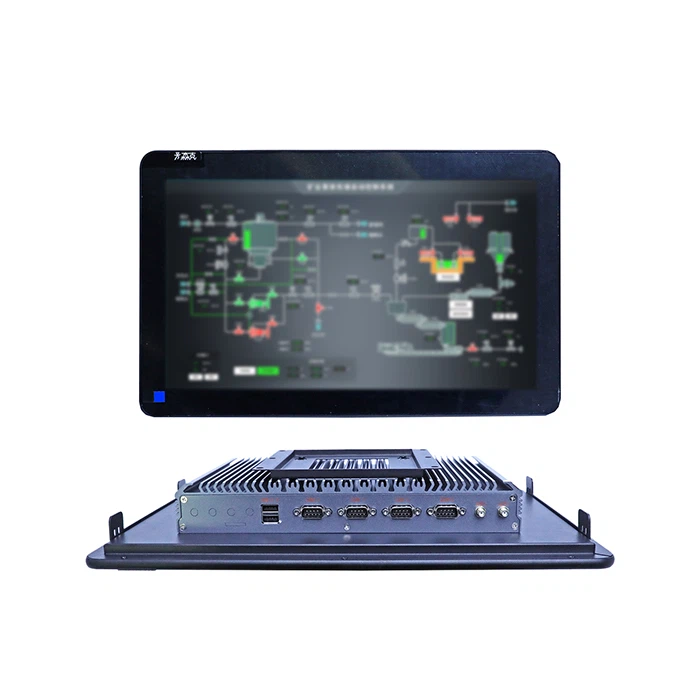
At the same time, the environmental adaptability of touchscreen computers is constantly improving, capable of operating in complex environments of intelligent factories, ensuring the stability and continuity of data interaction. For example, in the high-temperature and dusty workshops of intelligent factories, touchscreen computers have wide temperature design and high protection levels, able to operate stably; In environments with strong electromagnetic interference, touchscreen computers exhibit excellent anti-interference capabilities, ensuring the accuracy of data transmission.
In the future, as the industrial 4.0 technology continues to upgrade, touchscreen computers will play an even more important role in intelligent factories. Their functions will be further expanded, integrating technologies such as artificial intelligence, big data, and the Internet of Things, achieving more intelligent interaction, more efficient data processing, and more precise command transmission, becoming an indispensable core equipment in intelligent factories. At the same time, touchscreen computers will be deeply integrated with industrial robots, industrial internet, cloud platforms, etc., promoting the development of intelligent factories towards greater efficiency, greater intelligence, and greater sustainability, and facilitating industrial upgrading in the era of industrial 4.0.