Wide Temperature Industrial Screen Test: Performance of Senke Display Under High and Low Temperatures in Industrial Environments
Product knowledge 2026-04-16
In industrial settings, high and low temperature conditions are common. These include unair-conditioned workshops, outdoor production lines, low-temperature storage areas, and high-altitude cold regions. The temperature variations between day and night, and between seasons, can be quite significant, which poses high requirements for the wide temperature adaptability of industrial displays. Ordinary industrial displays often experience issues such as startup delays, image distortion, touch control failures, and even shutdowns under extreme temperature conditions, which affect the normal operation of the production line. To verify the wide temperature performance of Senke industrial displays, we simulated various industrial high and low temperature scenarios and conducted actual tests to comprehensively observe their performance in different temperature environments, providing a real reference for industrial scene selection.
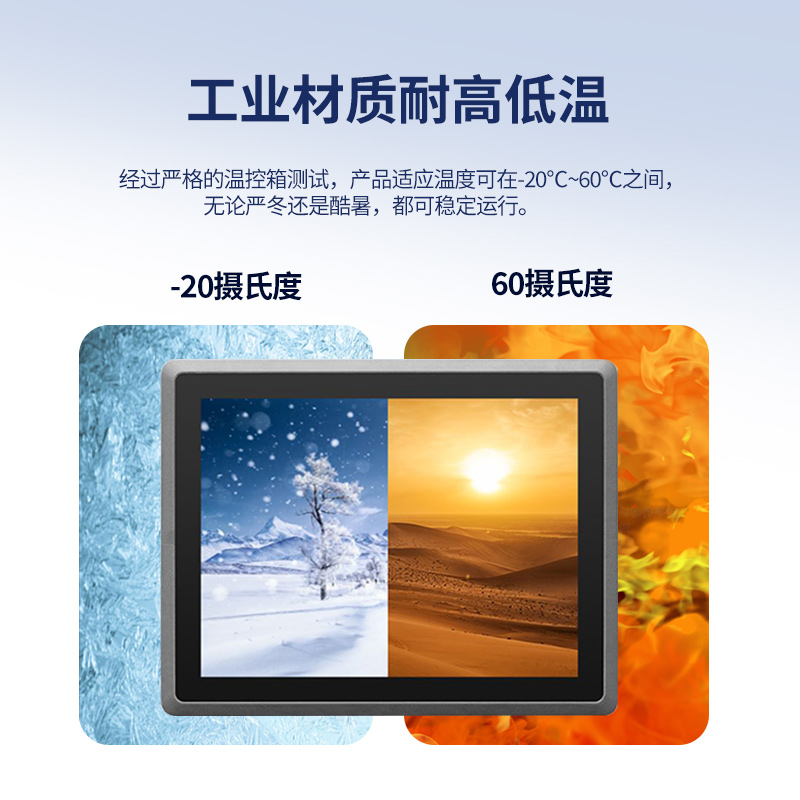
This test focused on the common high and low temperature ranges in industrial scenarios, simulating three core scenarios: low temperature -20°C, normal temperature 25°C (control), and high temperature 55°C. We also included temperature shock tests to simulate the actual working conditions of industrial sites with significant day-night temperature differences and sudden changes in environmental temperature. We focused on testing the four core indicators of the Senke industrial display: startup speed, image display, touch response, and signal stability. We recorded the equipment’s operating status throughout the process to ensure that the test data accurately reflected the actual usage scenarios.
Low Temperature Scenario Test: Simulating scenarios such as northern cold workshops and low-temperature cold storage areas, we maintained the test environment temperature at -20°C and conducted continuous testing for 24 hours to observe the equipment’s performance. Under this temperature, ordinary industrial displays often experience problems such as reduced liquid crystal molecule activity and difficult startup, and may even fail to light up properly. However, the Senke industrial display has a smooth startup process without significant delays, completing the lighting within 10 seconds after power-on, without the need for additional preheating. After startup, the image quickly reaches a clear state without any blurring, smearing, or color deviation, and the color reproduction is consistent with normal temperatures.
In low-temperature environments, the touch response and signal stability of the equipment are equally crucial. During the test, we repeatedly operated the screen, whether it was clicking on parameter settings or sliding to view data, the touch response was sensitive and smooth. Even with thin gloves, precise identification could be achieved without any lag or accidental touch. At the same time, connecting the display to PLCs and industrial control computers, the signal transmission was stable without interruptions or screen flickering. Even when running continuously for 24 hours in the low-temperature environment, the equipment did not experience black screens, restarts, or other failures. The core components operated stably without any performance degradation due to low temperatures. This is thanks to the wide-temperature liquid crystal material selected by Senke, which can maintain good molecular activity in low temperatures, combined with an optimized circuit design, effectively reducing the impact of low temperatures on signal transmission and avoiding phenomena such as lag and system crashes.
High Temperature Scenario Test: Simulating scenarios such as southern hot factories and outdoor production lines, we maintained the test environment temperature at 55°C, while also simulating poor ventilation conditions in the workshop. We conducted continuous testing for 24 hours, focusing on testing the equipment’s heat dissipation performance and operational stability. High temperatures can cause heat accumulation inside the equipment, leading to component aging, black screens, and performance degradation. This is a common problem for industrial displays in high-temperature scenarios. The Senke industrial display adopts a non-fan passive cooling design, relying on a high-conductivity aluminum alloy casing and scientific heat dissipation patterns to quickly transfer the equipment’s generated heat to the outside. During the test, the surface temperature of the equipment was well controlled, with no obvious overheating, and the body did not deform, and there were no signs of aging on the casing.
In high-temperature environments, the display of the Senke industrial display maintains stable image display and operating status. The high-definition panel presents clear text, data, and charts without any color deviation, ghosting, or brightness degradation caused by high temperatures. The anti-glare coating can effectively resist simulated strong light exposure, ensuring the visibility of the screen. Meanwhile, the touch response of the device remains sensitive, the signal transmission is stable, and there are no abnormalities in the connection with industrial control equipment. During the 24-hour continuous operation period, no faults occurred. This demonstrates excellent high-temperature adaptability. Such stable performance is inseparable from its efficient heat dissipation design and the strict selection of industrial-grade components, which effectively avoids the degradation of component performance and overheating shutdown in high-temperature environments.
Temperature shock test: Simulate the scenario of drastic temperature differences between day and night in industrial sites and sudden changes in environmental temperature. The environmental temperature is quickly switched from -20℃ to 55℃, with an interval time controlled within 15 minutes, and the test is repeated 10 times to observe the adaptability of the device. During the actual test, the Senke industrial display did not experience abnormal situations such as black screen, restart, or picture distortion during the temperature shock process. After switching to the target temperature, no debugging was required, and the picture and touch response quickly returned to stability, with no interruption in signal transmission. This is due to the optimized structure and temperature control design of the device, which can effectively resist the thermal expansion and contraction stress caused by sudden temperature changes and avoid internal wire loosening and component damage. It is suitable for industrial scenarios with frequent temperature fluctuations, such as outdoor energy stations and production lines at high altitudes.
This actual test also found that the Senke industrial display has good durability in both low and high temperature environments. In the low-temperature environment, the metal casing of the device has no cold brittleness, the sealing structure remains tight, and there are no gaps or loosening problems, effectively blocking the invasion of external cold air and dust. In the high-temperature environment, the coating of the casing does not peel off or age, the interface does not loosen, and after long-term operation, the performance of the core components does not show significant degradation. This further confirms its wide temperature adaptability and product reliability. This performance is in line with the long-term high-load and multi-temperature difference usage requirements of industrial scenarios, reducing equipment failures and replacement frequencies caused by temperature issues.
The high and low temperature environments of industrial scenarios are important tests for the stable operation of industrial displays. The wide temperature adaptability directly relates to the service life of the equipment and the stability of the production line. This actual test shows that the Senke industrial display can maintain good startup performance, picture display, touch response, and signal stability in both -20℃ and 55℃ environments. It can also adapt to temperature shock scenarios and meet the usage requirements of various high and low temperature industrial scenarios, such as outdoor energy stations and production lines at high altitudes.
Unlike ordinary industrial displays that “fail to adapt” to extreme temperatures, the Senke industrial display achieves stable operation in both high and low temperatures through the selection of wide-temperature components, scientific heat dissipation and temperature control design, and structural optimization. It does not require additional protective equipment and can adapt to complex scenarios such as severe cold, high temperatures, and drastic temperature differences. For industrial enterprises with temperature-related problems, such actual test results also provide a real and reliable reference for their selection, allowing the equipment to perform stably in various extreme temperature scenarios and ensure the smooth operation of the production line.