Application of Industrial Touchscreen Computers in China’s Intelligent Manufacturing Lines
Product knowledge 2026-03-31
Intelligent manufacturing lines are characterized by digitalization, intelligence, and collaboration. They break through the barriers of traditional discrete production and achieve precise control, efficient collaboration, and data interoperability throughout the production process. The industrial touchscreen computers in China, as the core terminal for human-computer interaction, with stable operation performance, rich interface adaptability, and flexible scene adaptability, deeply integrate into every aspect of the intelligent manufacturing lines, becoming the key link connecting operators, industrial equipment, and management systems, promoting the transformation of production processes from “manual control” to “intelligent management”, providing solid support for the efficient and stable operation of intelligent manufacturing lines. Their applications have covered the entire process of line control, data collection, and operation management.
1. Core Requirements of Intelligent Manufacturing Lines for Terminal Devices
The continuous and intelligent operation of intelligent manufacturing lines has placed special demands on terminal interaction devices that are different from those in traditional industrial scenarios. The core requirements fall into three aspects, which also determine the application direction and adaptation focus of industrial touch screen computers.
(1) High Stability and Continuous Operation Capability
Most intelligent manufacturing production lines operate in a 7×24-hour continuous mode. The stability of the terminal equipment directly affects the efficiency of the production line operation. If a malfunction occurs, it may cause the production line to stop, resulting in production losses. Therefore, the terminal equipment must have the ability to operate without faults for a long time, be able to meet the continuous operation requirements of the production line, and also have the functions of self-diagnosis and self-recovery of faults, reducing the need for manual intervention and ensuring the continuity of the production process.
(2) Multi-device Collaboration and Data Interconnection Capability
The intelligent manufacturing production line includes various devices such as PLC, industrial robots, sensors, AGV, as well as management platforms like MES (Manufacturing Execution System) and SCADA (Data Acquisition and Monitoring System). The terminal devices need to have a rich set of interfaces and wide compatibility with various protocols, enabling seamless connection with various devices and systems, achieving real-time data collection and precise command dispatch, and breaking through the collaborative link of “equipment – terminal – system” in the production line to realize data interconnection and collaborative control.
(III) Scene Adaptability and Operational Convenience
The intelligent manufacturing production lines present diverse scenarios, including precision processing, material handling, quality inspection, etc. Some of these scenarios involve complex conditions such as dust, oil stains, vibration, and strong light. Moreover, operators need to quickly complete tasks such as parameter setting, status monitoring, and fault diagnosis. Therefore, the terminal equipment must have excellent environmental adaptability, as well as simple and intuitive operation, to reduce the training costs for operators and enhance operational efficiency.
2. Core Application Scenarios of Chinese Industrial Touchscreen Computers in Intelligent Manufacturing Lines
Chinese industrial touchscreen computers, in line with the requirements of intelligent manufacturing lines, deeply penetrate the entire production process and play differentiated roles at various stages, forming an application model that is tailored to the actual needs of the production lines. The main scenarios include the following five.
(1) Real-time Production Line Control: Achieving Precise Operations and Command Issuance
In the core production stage of the intelligent manufacturing line, the industrial touch screen computer serves as the on-site control terminal, undertaking core functions such as parameter setting, process control, and equipment start/stop. It is the direct medium for the interaction between operators and the production line equipment. Operators can set production parameters (such as processing accuracy, running speed, material ratio, etc.) through the touch interface, issue commands for equipment start/stop, process switching, and receive real-time feedback on equipment operation status to ensure that the production process proceeds according to standards.
For instance, in an intelligent production line for mechanical processing, industrial touch-screen computers connect with CNC machines, servo drives, and other equipment. Operators can adjust cutting parameters and feed speeds through the touch interface, and view the operation status of the machine in real time. When there are abnormal parameters, they can quickly adjust and correct them to ensure processing accuracy. In an electronic manufacturing production line, terminal devices can achieve coordinated control of equipment such as surface mounters and welding machines, issue production instructions, and synchronously coordinate the operation rhythms of each device to avoid process disconnection and improve production line efficiency. In some production lines, touch-screen computers can also implement intelligent guidance for assembly, by dynamically displaying the assembly process flowchart to guide operators to complete each step of the operation, preventing omissions or errors, and improving assembly accuracy.
(2) Data Collection and Visualization: Connecting the Data Chain of the Production Line
Data is the core support for the optimization and upgrading of the intelligent manufacturing production line. The Chinese industrial touch screen computers, with their rich interfaces and protocol compatibility capabilities, have become the key terminal for data collection and visualization of the production line. Through serial ports, network ports, USB interfaces, etc., the equipment connects various sensors and measuring devices on the production line to collect real-time production data, including equipment operation parameters, production progress, material consumption, product qualification rate, etc. At the same time, the collected data is preliminarily processed and visually presented in intuitive forms such as charts and curves, making it convenient for operators to grasp the operation status of the production line in real time.
In addition, industrial touch screen computers can synchronize the collected data and upload it to management systems such as MES and SCADA, achieving data interconnection and enabling the management layer to obtain production decision-making basis. For example, in the new energy battery production line, terminal devices collect parameters such as battery foil thickness, voltage, and temperature in real time, display the parameter change curves through a visual interface, and promptly alert when the parameters exceed the threshold. At the same time, the data is uploaded to the management system, facilitating managers to analyze production process loopholes and optimize production procedures. In the food processing production line, data such as production environment temperature and humidity, and material batches can be collected, enabling traceability of the production process and ensuring product quality compliance. Some terminals, with edge computing capabilities, can perform real-time analysis and local preprocessing of the massive collected data, reducing the delay in transmission to the cloud and improving data processing efficiency.
(III) Equipment Operation and Fault Warning: Reducing Production Line Shutdown Risks
The efficient operation of intelligent manufacturing lines is inseparable from the stable support of equipment. The Chinese industrial touch screen computers, with their built-in fault self-diagnosis function and remote operation module, provide a strong guarantee for the operation of production line equipment. The terminal equipment continuously monitors the operating status of various equipment on the production line, including parameters such as equipment operating temperature, vibration frequency, and energy consumption. When an abnormality is detected, it promptly records the fault information and displays the fault location, type, and preliminary handling suggestions through the touch screen interface, helping maintenance personnel quickly identify and troubleshoot the faults, thereby reducing downtime.
For large-scale intelligent manufacturing lines, industrial touch screen computers support remote operation and maintenance functions. Maintenance personnel can remotely view the operating status of the equipment, read fault logs, and even remotely adjust equipment parameters and perform simple fault repairs via the network, thereby reducing on-site maintenance costs and improving maintenance efficiency. For example, in the intelligent welding assembly line of automobiles, the terminal equipment can monitor the operating status of the welding robots in real time. When a robot fails, it will promptly issue an alert and display the cause of the failure. Maintenance personnel can respond quickly and handle the issue, significantly reducing the response time for equipment failures. In the intelligent warehousing line, the terminal equipment can monitor the operating status of AGVs, vertical warehouses, and other equipment, and predict equipment failure risks in advance to avoid disruptions in material circulation due to equipment downtime.
(4) Material Management and Scheduling: Achieving Precise Control of Production Line Materials
Material management is a crucial aspect for the efficient operation of intelligent manufacturing lines. The Chinese industrial touch screen computers, by integrating RFID readers, barcode scanners, and other devices, enable precise control of all aspects of production line materials, including material entry, exit, circulation, and inventory checks. Operators can query real-time information such as material inventory, material location, and material batch numbers through the touch interface, issue material scheduling instructions, and ensure timely supply of materials, avoiding shortages or overstocking.
For instance, in the intelligent warehousing and material management scenario, industrial touch-screen computers, by connecting to RFID readers and barcode scanners, can achieve automatic registration of material entry and exit and real-time update of inventory. Operators can complete the entry process by swiping their employee cards and scanning the goods barcodes, thereby improving operational efficiency and inventory accuracy. In the material flow环节 of the production line, terminal equipment can track the location of materials in real time, issue material distribution instructions based on the production progress, ensure that materials are accurately delivered to the corresponding workstations, and achieve precise matching between materials and production processes, reducing material waste and flow losses. In some scenarios, material error prevention can also be achieved through terminals. Through RFID automatic identification of material batches and comparison with work orders, the risk of using the wrong materials can be eliminated.
(5) Quality Inspection and Traceability: Ensuring Product Compliance
Quality control is one of the core goals of intelligent manufacturing. Industrial touch screen computers in China play a significant role in the quality inspection and traceability process on the production line. At the quality inspection station, the terminal equipment connects with visual inspection equipment, detection instruments, etc., to collect real-time product inspection data, such as size accuracy, appearance defects, performance parameters, etc. The inspection results are displayed through the touch screen interface, and unqualified products are marked. At the same time, the inspection data is recorded to achieve traceability of product quality.
For instance, in a precision electronic production line, industrial touch-screen computers are connected to visual inspection equipment, displaying real-time images of product appearance inspections. Through AI algorithms, surface defects of the products are automatically identified, and the inspection data is automatically recorded and generated as statistical process control (SPC) charts. If the data exceeds the tolerance range, an immediate alarm is triggered, helping operators promptly identify quality issues and optimize production processes. In an automotive component production line, terminal equipment can record the production parameters, inspection results, and operator information of each product, enabling full-process traceability from raw materials to finished products. When quality issues occur, the problem link can be quickly located, reducing quality losses.
III. Adaptability Advantages of Chinese Industrial Touchscreen Computers in Production Line Applications
Compared to ordinary industrial terminals, Chinese industrial touchscreen computers can better meet the requirements of intelligent manufacturing production lines. The core advantages lie in three aspects, providing support for their wide application.
(1) Strong environmental adaptability, suitable for complex conditions of production lines
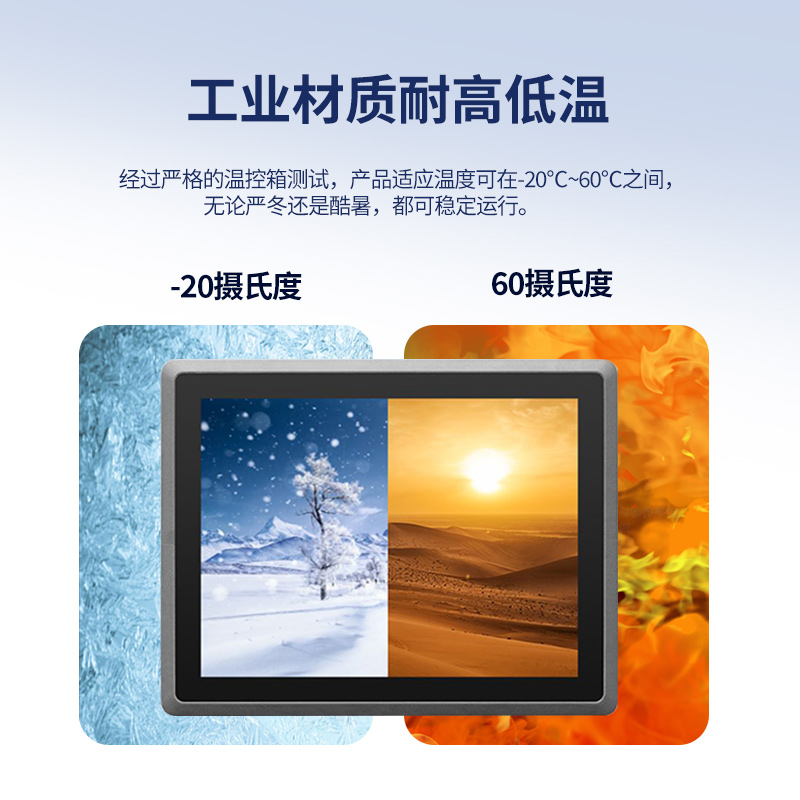
Some sections of the intelligent manufacturing production lines encounter complex conditions such as dust, oil stains, vibration, and strong light. The industrial touch screen computers used in China’s industrial products adopt industrial-grade components and protective designs. The front panel protection level generally reaches IP65 or above, which can effectively prevent dust, oil stains, and liquid from invading; the wide-temperature design can adapt to different temperature environments of the production lines and avoid problems such as black screen of the screen and malfunction of touch control; the anti-vibration and anti-electromagnetic interference design can withstand the vibration and electromagnetic radiation generated by the operation of production line equipment, ensuring the stable operation of the equipment and meeting the requirements of complex conditions of the production lines. For example, in the food processing production line, the fully sealed design with IP65 high protection level can resist high-pressure water gun rinsing and cleaning agent erosion; in the mechanical processing production line, the reinforced body and shock-absorbing structure can effectively cope with the vibration generated by the operation of the machine tool, avoiding equipment loosening or abnormal display.
(2) Wide compatibility of interfaces and protocols, supporting multi-device collaboration
The equipment types in the intelligent manufacturing production line are diverse, and there is a high requirement for the compatibility of interfaces and protocols of the terminal devices. The Chinese industrial touch screen computers are equipped with a rich range of interfaces, including RS-232/485 serial ports, gigabit network ports, USB3.0 interfaces, GPIO interfaces, etc., which can connect sensors, PLCs, industrial robots, AGVs and other external devices, meeting the needs of various scenarios such as data collection and command issuance. At the same time, the equipment supports mainstream industrial protocols such as Modbus, Profinet, EtherNet/IP, and OPC UA, and can be seamlessly connected with different brands and types of control systems, reducing the difficulty of system integration and improving the efficiency of production line collaboration.
(3) Outstanding System Adaptability, Meeting the Requirements of Multiple Operating Systems
As the process of domestic substitution progresses, the adaptability requirements of intelligent manufacturing production lines to operating systems have become more diverse. Chinese industrial touch-screen computers can be compatible with mainstream operating systems such as Windows, Linux, and Android, and also support domestic operating systems like Yigeng Keryun and Wuxi UOS, meeting the system deployment needs of different production lines. For example, in traditional manufacturing production lines, the Windows system can be used to adapt to existing industrial software; in intelligent manufacturing upgrade production lines, the use of domestic operating systems can achieve data security and autonomy control, meeting the development needs of the information technology innovation industry.
IV. Application Trends of Industrial Touchscreen Computers in China’s Intelligent Manufacturing Lines
With the continuous iteration of intelligent manufacturing technology, the application scenarios of industrial touchscreen computers in China will further expand, and their functions and performance will continue to be optimized, presenting three major development trends.
(1) Deepening of Edge Computing and Intelligent Integration
In the future, industrial touch-screen computers will further integrate edge computing modules to enhance their local data processing capabilities, enabling real-time data analysis, anomaly detection, and rapid response to instructions, reducing reliance on the cloud and improving the real-time performance and security of production lines. For example, in the quality inspection scenario of the production line, the terminal can integrate an AI algorithm module to complete product defect identification and determination locally, without uploading data to the cloud, thereby reducing the risk of network latency and improving inspection efficiency.
(2) Enhanced Customization in Specific Industries
The intelligent manufacturing lines in different industries have distinct requirements. Industrial touch screen computers will evolve towards a more customized approach for specific industries. For sectors such as new energy, semiconductors, biomedicine, and high-end equipment, the hardware configuration and software interface will be optimized to suit the industry-specific production processes and control requirements. For instance, in semiconductor production lines, the terminals can incorporate high-sensitivity touch control and anti-static designs to adapt to dust-free and highly static environments; in biomedicine production lines, the terminals can support data encryption and compliance tracing to meet the industry’s quality control standards.
(3) Popularization of Lightweight and Modular Design
To adapt to the diverse installation scenarios of production lines, industrial touch screen computers will evolve towards lightweight and modular designs. They will optimize the body structure, reduce the size and weight of the equipment, and adopt modular hardware design to facilitate component replacement and maintenance, thereby enhancing the convenience of production line operation and maintenance. For instance, the cantilevered and embedded terminals will be further lightweighted to fit into narrow workstation spaces; the modular design enables independent replacement of components such as interfaces and heat dissipation modules, reducing maintenance costs and extending the service life of the equipment.
V. Conclusion
As the core interactive terminal of intelligent manufacturing production lines, Chinese industrial touch screen computers, with their adaptability to the environment, multi-device collaboration capabilities, and system compatibility advantages, deeply integrate into the entire process of production line control, data collection, operation management, material control, quality inspection, etc., becoming an important support for promoting the efficient operation and upgrading of intelligent manufacturing production lines. With the continuous development of technologies such as edge computing, customized development, and lightweight design, the application value of industrial touch screen computers will be further highlighted, providing more solid hardware support for the digital and intelligent transformation of Chinese intelligent manufacturing production lines and helping the manufacturing industry achieve high-quality development.