Inspection of China’s Industrial All-in-One Computer Factory: The Secrets of Reliability Manufacturing in Harsh Environments
Product knowledge 2026-03-21
Entering the production workshop of the Chinese industrial all-in-one computer factory, there are no excessive promotional slogans. Instead, there is the orderly operation of the assembly line, the precise running of the testing equipment, and the concentrated operation of the technicians. Unlike the large-scale production of ordinary commercial computers, the manufacturing of industrial all-in-one computers is centered around the core of “reliability” from the very beginning to the end. It focuses on the strict requirements of industrial scenarios, covering the selection of components, production assembly, to testing and inspection. Every step is hidden with rigorous manufacturing logic. Industrial all-in-one computers are widely used in many fields such as metallurgy, chemical industry, cement, and semiconductor. These scenarios often involve complex working conditions such as high temperature, high dust, strong vibration, and high humidity, which place extremely high demands on the stability and durability of the equipment. In this visit, we delved into the entire production process of the factory, disassembling the manufacturing secrets of how Chinese industrial all-in-one computers maintain reliable operation in harsh environments.
The manufacturing of reliability begins with rigorous selection at the source, which is the fundamental prerequisite for industrial all-in-one computers to cope with complex environments. In the component warehouse of the factory, we can see that all the components that are put in stock have undergone strict screening and inspection, rather than being simply purchased and piled up. The core difference between industrial all-in-one computers and ordinary commercial computers lies first in the compatibility of the components. Ordinary commercial components cannot withstand the harsh environment of industrial scenarios and are prone to aging, short circuits, and malfunctions. Therefore, the factory has established a strict standard system for component selection at the source to avoid reliability risks from the very beginning.
In terms of core components, the factory prefers to use industrial-grade components rather than consumer-grade ones. For instance, the motherboard selects industrial-grade boards, which have an optimized circuit layout and stronger anti-electromagnetic interference capability compared to commercial motherboards. They can withstand the strong electromagnetic radiation generated by equipment such as frequency converters and motors in industrial environments, preventing data transmission interruptions or command errors. The processor selects wide-temperature chips, suitable for an extreme temperature range of -20°C to 70°C. It can operate stably in high-temperature environments in metallurgical workshops and start normally in outdoor low-temperature scenarios, meeting the environmental requirements of different industries. In the display module, industrial-grade touch screens are selected. They use high-brightness and high-contrast panels, are resistant to strong light and scratches. Even in outdoor strong light or dust-covered workshops, they can ensure clear display and sensitive operation. They also have waterproof and dustproof features, and some products can reach a protection level of IP65 or above, effectively resisting the erosion of dust and liquid splashes.
Apart from the core components, the seemingly insignificant auxiliary materials have also undergone strict selection. For instance, the body seal uses a silicone sealing ring that is resistant to high temperatures and aging, rather than ordinary rubber material. This ensures that the sealing performance remains intact even in long-term high-temperature environments, preventing dust and moisture from entering the interior of the device and damaging the core components. The connection cables are selected from industrial-grade cables that are resistant to wear and interference. They have a thicker diameter and greater toughness, which can adapt to frequent bending and vibrations in industrial scenarios, preventing cable breakage that could cause equipment malfunctions. The factory technicians explain that during the component selection process, multiple rounds of tests and comparisons are conducted, and even aging tests under various harsh conditions are simulated. Only components that pass all the test standards can enter the production process. This seemingly cumbersome process is the first line of defense to ensure the reliability of the product.
Lean production and standardized assembly are the core aspects of reliable manufacturing, and they are also the key to converting component advantages into product strength. When entering the factory’s production workshop, the automated production lines work in harmony with manual operations. Each process has clear operation standards and quality control requirements, eliminating the impact of human operational errors on product reliability. Unlike the rapid assembly of ordinary computers, the assembly of industrial all-in-one computers pays more attention to detail control, focusing on every detail of environmental adaptability.
In the SMT (Surface Mount Technology) assembly process, the factory employs an automated assembly line to ensure the high precision and consistency of the soldering of the mainboard components. The soldering accuracy reaches the micron level, significantly reducing the problems of incomplete or false soldering of components. Subsequently, it will undergo multiple processes such as AOI (Automatic Optical Inspection) and SPI (Solder Paste Inspection) to detect any minor welding defects. In the assembly of the body, the technicians operate strictly according to the standardized operation instructions. Especially for the routing and fixation of internal cables, they follow the industrial equipment specifications to ensure reliable connections in a vibrating environment, facilitating heat dissipation and maintenance. To meet the vibration requirements of industrial scenarios, the factory has optimized the design of the body structure. It uses a cast aluminum body and pairs it with reinforced brackets to enhance the body’s vibration resistance. At the same time, the internal core components are reinforced to prevent components from loosening or falling off due to vibration during transportation or operation.
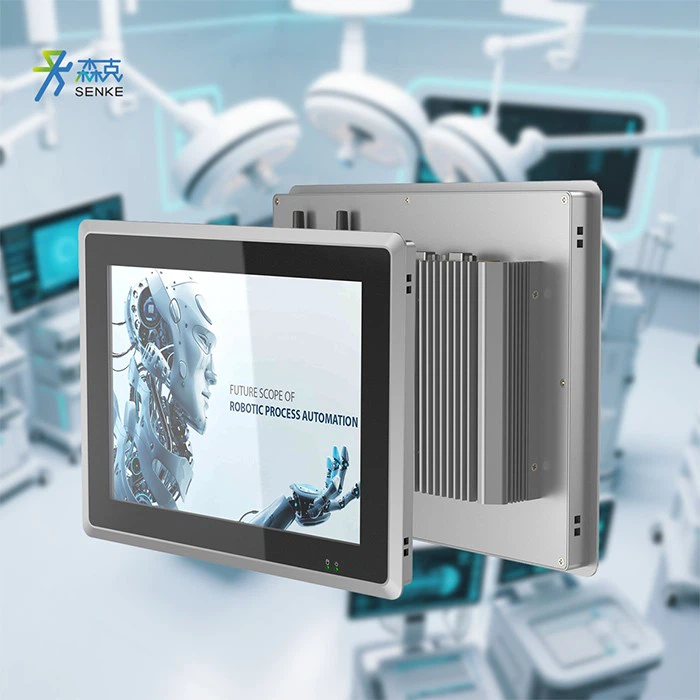
Heat dissipation design is the key for industrial all-in-one computers to cope with high-temperature environments and is also a focus in the production process. Factories adopt fanless heat dissipation designs or fin-type heat dissipation structures based on the temperature characteristics of industrial scenarios. The fanless design can prevent dust from entering the internal components of the machine, reducing noise, and is suitable for scenarios with high dust and quiet requirements. The fin-type heat dissipation structure increases the heat dissipation area to enhance the efficiency and ensure that the core components’ temperatures remain within the safe range during long-term operation in high-temperature environments, preventing performance degradation or failures due to overheating. Technicians explain that the heat dissipation design of each product undergoes repeated simulation tests and is optimized based on different temperature scenarios in various industries to ensure that the heat dissipation effect meets the actual usage requirements. Additionally, in the wiring design, the factory focuses on the balance between heat dissipation and anti-interference, optimizes the layout of the lines to avoid poor heat dissipation caused by tangled cables, and reduces interference between different lines to ensure the stable operation of the equipment.
Comprehensive and strict testing throughout the entire process is the final line of defense for reliable manufacturing and is also the key to ensuring that the products meet the requirements of industrial scenarios. The Chinese industrial all-in-one computer factory has established a testing system covering the entire production process. From the entry of components, the production process to the final product leaving the factory, each stage has corresponding testing items. Through a scientific testing process, potential faults can be exposed in advance, achieving “stable upon leaving the factory”.
During the component warehousing inspection process, the factory conducts random sampling inspections on each batch of components, focusing on testing the performance, stability, and environmental adaptability of the components. For example, chips undergo high and low temperature tests, touch screens undergo anti-scuffing and anti-strong light tests, and sealing rings undergo high-temperature and anti-aging tests. Any components that fail the inspection are strictly prohibited from being warehoused. In the production process inspection stage, multiple inspection nodes are set up to conduct real-time inspections on the motherboard soldering, body assembly, and heat dissipation performance. Any problems identified are immediately halted for rectification to prevent substandard semi-finished products from flowing into the next process. In the finished product inspection stage, the factory builds a dedicated reliability testing laboratory to simulate various harsh industrial conditions and conduct comprehensive tests on the finished products. The test items cover temperature adaptability, humidity adaptability, vibration tests, power fluctuation tests, lifespan tests, and other aspects.
In the laboratory, we observed that the industrial all-in-one computer continued to operate for several hours in a high-temperature test chamber at 70℃, to test its performance stability. In the temperature shock test, the equipment rapidly switched between -20℃ and 70℃ to simulate the extreme temperature difference in outdoor scenarios, verifying its structural integrity and performance stability. On the vibration test platform, the equipment endured different frequencies of vibrations to simulate strong vibration scenarios such as industrial assembly lines and mines, testing the reliability of component connections. In the humidity test, the equipment operated for a long time in a high-humidity environment to test the moisture-proof design and the moisture resistance performance of components. All these tests followed relevant standards such as GB/T 2423 and IEC60068, ensuring the scientificity and rigor of the test results. Only products that pass all the test items and meet the standards for each indicator can be labeled as qualified and enter the market.
Scenario-based verification and continuous optimization are extensions of reliability manufacturing and are also the core logic for factories to meet industrial demands. The diversity of industrial scenarios determines that the reliability requirements of industrial all-in-one computers vary. The harsh environments in different industries are also different, and the requirements for equipment also differ. Therefore, factories not only focus on controlling the reliability of the production process but also conduct scenario-based verification for different industry scenarios and continuously optimize product design and manufacturing processes based on the verification results.
For instance, in response to corrosive gases, high temperatures, and high dust environments in the chemical industry, factories apply special protective treatments to their products. They use nano-coating technology on the surface of the machines to enhance their resistance to acid and alkali erosion, and optimize the sealing design to increase the protection level, preventing corrosive gases and dust from entering the machines. For the high-temperature scenarios in the metallurgical industry, they further optimize the heat dissipation structure and select components with stronger high-temperature resistance to ensure the equipment operates stably in high-temperature environments for a long time. For scenarios with strong vibrations such as mines and logistics, they strengthen the reinforcement of the machine body and fix the components to enhance the anti-vibration ability, avoiding data loss or equipment failures. Some factories also collaborate deeply with end-users, putting the products into actual industrial scenarios for long-term trial operation, collecting operation data, analyzing potential problems, and optimally designing and manufacturing the products to better meet the requirements of the scenarios.
During the visit, we discovered that the reliability manufacturing of China’s industrial all-in-one computer factories does not rely on the control of a single process. Instead, it has formed a closed-loop system of “selection – production – testing – optimization”, with each step centered around “adapting to harsh environments”. Every detail conceals the pursuit of reliability. This manufacturing logic stems from the actual needs of industrial scenarios and benefits from the technological upgrading of the domestic manufacturing industry. With the continuous advancement of industrial digital transformation, the factories have continuously accumulated technical knowledge in reliability manufacturing, gradually forming a set of manufacturing standards that are tailored to China’s industrial scenarios.
Compared with international brands, the advantages of Chinese industrial all-in-one computer factories lie not only in their profound understanding of local industrial scenarios, but also in their ability to quickly respond to scenario demands, optimize manufacturing processes, and enhance product reliability. Currently, the industrial all-in-one computers produced by domestic factories have been widely used in various demanding industrial environments, such as metallurgical workshops, chemical plants, mining sites, and cement production lines, operating stably in these environments and providing strong support for the continuity of industrial production.
Of course, there is still room for improvement in the reliability manufacturing aspect of Chinese industrial all-in-one computer factories. The adaptability of core components for some high-end scenarios, as well as the long-term stability in extreme environments, still require continuous optimization. However, with the continuous advancement of technology and the continuous accumulation of manufacturing experience, the factories are gradually improving their reliability manufacturing systems, increasing investment in research and development, and promoting the upgrade of products towards higher reliability and better environmental adaptability.
After the visit, we deeply realized that the reliability of Chinese industrial all-in-one computers is not accidental but stems from the factories’ strict control over every aspect and their respect and deep exploration of industrial scenarios. In the wave of industrial digital transformation, the reliability in a harsh environment is not only the core competitiveness of industrial all-in-one computers but also the foundation for the high-quality development of Chinese industrial all-in-one computer factories. In the future, as manufacturing technologies continue to upgrade and scenarios change constantly, Chinese industrial all-in-one computer factories will continue to adhere to the original intention of reliability manufacturing, continuously optimize manufacturing processes, and improve the detection system, so that every industrial all-in-one computer can operate stably in a harsh environment, providing solid hardware support for the intelligent transformation of China’s manufacturing industry.