Chinese industrial touchscreen computer factories: The path of domestication and breakthrough in intelligent manufacturing terminals
Product knowledge 2026-03-20
Industrial touchscreen computers are the core human-machine interaction terminals in intelligent manufacturing workshops, undertaking key functions such as data collection, equipment control, production line monitoring, and MES system integration. For a long time, the high-end industrial touch terminal market has been dominated by overseas brands, with core components and system solutions relying on external supplies, which has led to constraints in supply chain security, scene adaptation, and cost control. With the advancement of the manufacturing power strategy and the maturity of the domestic industrial chain, Chinese industrial touchscreen computer factories have taken technological breakthroughs and supply chain integration as their starting points, embarking on a path of domestication and industrial upgrading in parallel.
I. Industry Background: The Demand for Transition from Import Dependence to Self-Supply
The popularization of intelligent manufacturing and industrial internet has driven the upgrade of industrial touch terminals from standard display devices to intelligent terminals with edge computing, multi-protocol access, and wide-temperature and anti-interference capabilities. Key industries have put forward clear requirements for the autonomy and controllability of equipment. In fields such as energy, rail transit, high-end equipment, and military electronics, domestic solutions are given priority to ensure data security and supply chain stability.
China’s electronic manufacturing industry clusters have significant advantages. The Yangtze River Delta and the Pearl River Delta are home to a large number of factories with capabilities in whole machine design, structural processing, and module integration, forming a complete supporting system from panels, touch components to whole machine assembly. In the past, the industry was mainly concentrated in low and medium-end contract manufacturing, and there were gaps in high-end products in terms of chips, touch algorithms, and industrial-grade reliability design. Therefore, domestic substitution has become an inevitable trend.
II. Core Breakthroughs: Technological and Supply Chain Upgrades at the Factory Level
Chinese industrial touchscreen computer factories have achieved breakthroughs in four key areas: hardware reliability, localization of core components, system compatibility, and scenario customization.
- Mature industrial-grade reliability process
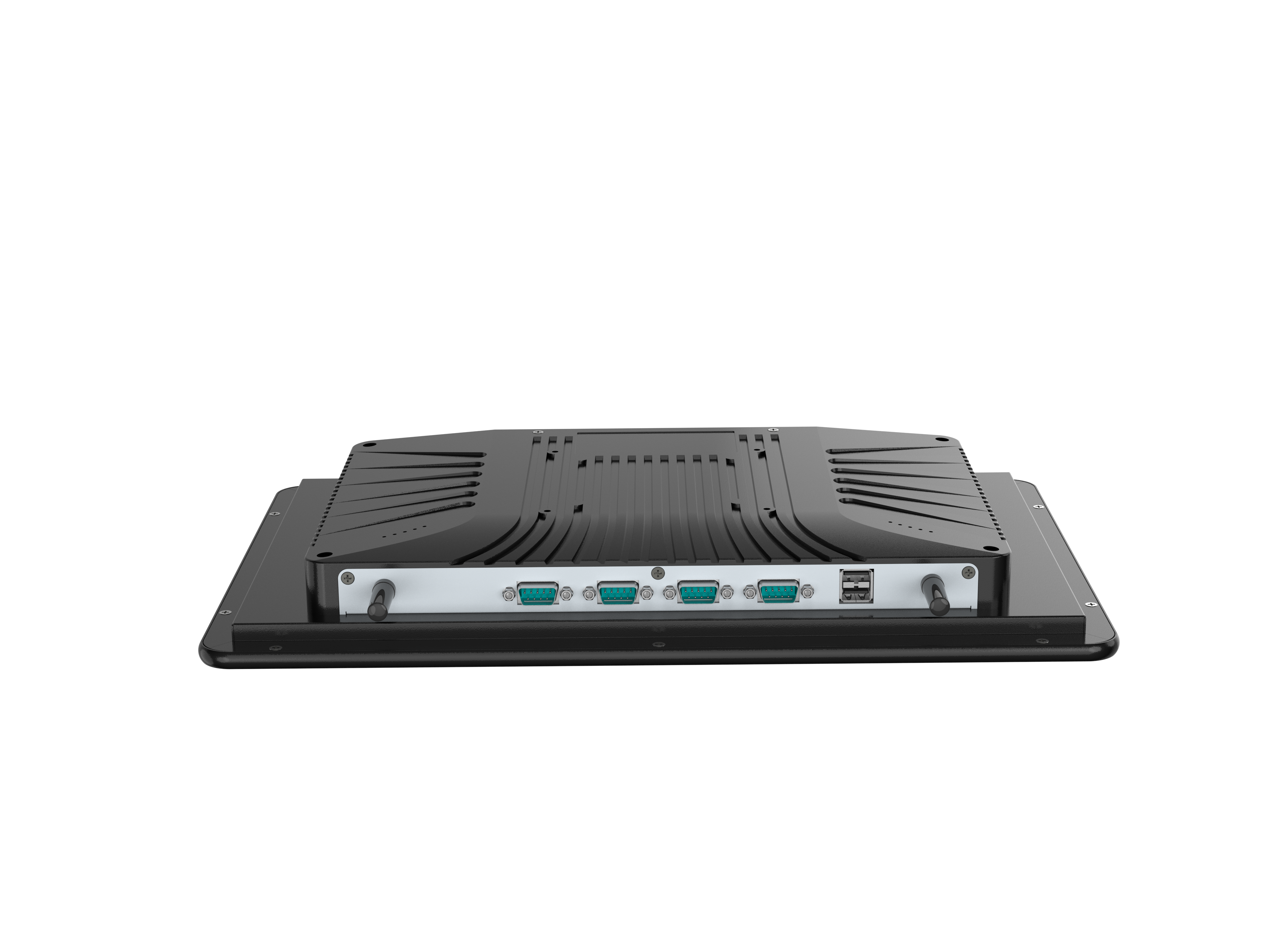
The factory has established a strict environmental adaptation system. The product can operate stably within a wide temperature range of -20℃ to 60℃, and supports IP65 dust and water resistance, anti-electromagnetic interference, and anti-surge impact, meeting the harsh working conditions of metal cutting, chemical industry, outdoor stations, etc. The fully enclosed fanless structure, aluminum alloy die-casting body, and industrial-grade tempered glass design significantly enhance the service life and on-site stability of the equipment. - Enhanced Local Supply Capacity of Core Components
The domestic production rates of upstream components such as panels, touch sensors, mainboard chips, and interface modules have been continuously increasing. Companies like BOE and CSOT have been steadily supplying industrial-grade display panels, and local touch solution providers have achieved mass production of high-precision capacitive and resistive touch modules. The mainboard is gradually adapting to domestic processor platforms and is paired with domestic embedded operating systems, forming an independent solution from hardware to software. - Refinement of Industrial Protocols and Software Ecosystem
Factory products support mainstream industrial buses and communication protocols, enabling seamless integration with PLCs, servo systems, sensors, MES, and SCADA systems. Some factories have introduced visual configuration tools that allow users to quickly customize interfaces, reducing on-site deployment and debugging costs, and adapting to new scenarios such as flexible production lines and digital twins. - Customized Manufacturing Capability Forms an Advantage
Relying on a mature supply chain and rapid prototyping capabilities, the factory can provide services such as size customization, interface expansion, structural modification, and system pre-installation based on industry demands. Compared with the long lead times and standardized products of overseas brands, local factories are more competitive in terms of response speed, scene adaptation, and service costs.
III. Supply Chain Restructuring: An Autonomous and Controllable Industrial Ecosystem
The breakthrough in localization is not only about the upgrading of the whole machine manufacturing but also the construction of a secure supply chain system. Chinese industrial touchscreen computer factories promote the coordination of upstream and downstream, reducing external dependence:
- Panels and touch control modules achieve stable domestic supply, reducing reliance on overseas high-end display components
- Motherboards and core boards adopt domestic chip solutions, enhancing the autonomy of the underlying hardware
- Operating systems and industrial software are adapted, forming a secure and controllable software environment
- Structural components, heat dissipation, power supplies and other accessories are fully localized, improving delivery efficiency and cost controllability
Supply chain integration enables factories to have the capacity for bulk delivery. The stability and consistency of products are gradually approaching international standards, while providing customers with more flexible technical support and spare parts services.
IV. Application Deployment: Empowering Various Scenarios of Intelligent Manufacturing
Domestic industrial touch screen computers have been widely applied in multiple industries on a large scale:
- Discrete Manufacturing: Serving as the human-machine interface for machine tools, robots, and assembly lines, enabling parameter setting, status monitoring, and fault alarm.
- Process Industry: Applied in scenarios such as chemical engineering, metallurgy, and water treatment, for data collection and remote control.
- Digital Workshop: Equipped with MES systems as electronic billboards, supporting production scheduling, quality traceability, and energy consumption management.
- Special Scenarios: In fields such as rail transit, energy storage power stations, and port machinery, ensuring continuous operation with high reliability.
Local factories have a deeper understanding of domestic scenarios and can quickly respond to industry standards and on-site demands, promoting the popularization of intelligent manufacturing terminals.
V. Development Challenges and Future Directions
The current industry still faces challenges: the supply capacity of high-end industrial chips and specialized sensors needs to be enhanced; some industrial protocols and software tools still rely on external sources; brand influence and international market recognition need to be continuously accumulated.
The future development direction is clear:
- Deepen core technology research and development, and enhance capabilities in touch control algorithms, edge computing, and low-power design.
- Improve the compatibility of domestic chips and operating systems, and build a full-stack independent solution.
- Promote the intelligent upgrade of products, integrating functions such as AI vision and predictive maintenance.
4. Expand overseas markets and participate in global competition with high cost-effectiveness and customization capabilities.
Conclusion
The domestic breakthrough of Chinese industrial touchscreen computer factories is a microcosm of the upgrading of China’s manufacturing industry. From assembly and OEM to independent research and development, and from reliance on imports to self-controlled supply chains, local enterprises have provided stable and reliable terminal support for intelligent manufacturing through technological innovation and in-depth exploration of scenarios. With continuous technological progress and the continuous improvement of the ecosystem, domestic industrial touch control terminals will occupy a more important position in the global market and lay a solid hardware foundation for the construction of a manufacturing power.