Key points of waterproof and dustproof structure design for industrial touch display modules
Product knowledge 2026-03-11
Industrial touch display modules, as the core component of industrial human-machine interaction, are widely used in complex scenarios such as chemical workshops, outdoor operation equipment, mining machinery, and food processing workshops. In these scenarios, there are often pollutants such as dust, moisture, and oil stains. If the waterproof and dust-proof structure design is not adequate, the pollutants can easily enter the module interior, causing touch control failure, display abnormalities, circuit short circuits, and other faults, which seriously affect the stability of equipment operation and even shorten the module’s service life and increase maintenance costs. The waterproof and dust-proof structure design of industrial touch display modules focuses on constructing a comprehensive protective barrier through reasonable structural layout, sealing design, and material selection to resist the invasion of various pollutants, while also taking into account the touch performance, display effect, and structural stability of the module. This article will systematically analyze the core design points of the waterproof and dust-proof structure, combined with industrial scene requirements, to provide professional references for module design, selection, and application.
I. Core Principles of Waterproof and Dustproof Design for Industrial Touchscreen Display Modules
The types, concentrations, pressures and usage environments of pollutants in industrial scenarios vary. The design of waterproof and dust-proof structures must follow the three core principles of targetedness, reliability and compatibility, to ensure that the protective effect is in line with the industrial application requirements, and to avoid redundant designs or insufficient protection:
Specificity principle: Design protective structures based on the characteristics of pollutants in specific application scenarios. For example, in mining and metallurgical sites with high dust concentrations, the focus is on dust prevention design; in chemical and food processing sites with high humidity and moisture content, the emphasis is on waterproof sealing while also considering corrosion prevention requirements; for outdoor scenarios, multiple protections such as waterproofing, dust prevention, and UV resistance need to be met simultaneously.
- Reliability Principle: The protective structure must possess long-term stability. Throughout the entire lifecycle of industrial equipment, it should be able to continuously resist the invasion of contaminants and not experience any sealing failure due to changes in environmental temperature, vibration, or other factors. At the same time, the structural design should avoid affecting the heat dissipation of the module, the sensitivity of touch control, and the clarity of display.
- Compatibility Principle: The waterproof and dustproof structure must be compatible with the overall structure, touch control method, and installation form of the module. For example, capacitive touch control modules need to take into account both sealing performance and touch signal transmission, while embedded installation modules need to meet the protection requirements of the equipment installation cavity to avoid the situation where the module cannot be integrated or used properly due to the design of the protective structure.
In addition, the design must comply with relevant industrial protection standards (such as IP protection level standards), clearly define the waterproof and dustproof grade targets for the modules, ensure that the design scheme conforms to industry norms, and provide a basis for the protection effect.
II. Core Design Points of the Waterproof and Dustproof Structure of Industrial Touch Display Modules
The waterproof and dustproof structure design of industrial touch display modules should focus on the three core aspects of “sealing protection, structural isolation, and material adaptation”. It should be carried out from four key parts: the casing, the panel and the frame, the interface, and the internal protection, to build a comprehensive and seamless protection system. The specific design points are as follows:
(1) Waterproof and dustproof design for the outer shell structure
The outer shell is the first protective barrier of the module. Its main function is to isolate external dust and moisture. The structural design directly determines the overall protective effect. The key points of attention include structural sealing, drainage and dust-proof design, as well as strength adaptation.
Shell structure sealing design: An integrated sealing structure is adopted to reduce the joint gaps and prevent contaminants from invading through the joints. Sealing grooves need to be designed at the joint parts of the shell, and appropriate sealing components (such as silicone sealing rings, fluorine rubber sealing rings) should be embedded. The size and depth of the sealing grooves need to match the sealing components to ensure that the sealing components can completely fill the gaps and form a tight fit after installation. At the same time, the corners of the shell are designed with rounded transitions to avoid sharp edges that may cause uneven force on the sealing components and result in gaps. - Drainage and Dust Prevention Design: For outdoor and humid environments, drainage holes need to be designed at the bottom of the housing to facilitate the timely discharge of accumulated moisture and liquids. These drainage holes should be equipped with waterproof plugs or waterproof透气 valves to prevent water vapor from flowing back when draining. In scenarios with high dust concentration, if there is an intake port on the housing, a dust filter screen should be designed. Use high-density metal screens or non-woven fabric dust-proof materials to intercept dust of different particle sizes. At the same time, a structure for removing the dust filter screen should be reserved to facilitate later cleaning and maintenance.
- Shell material selection: Select industrial-grade materials with waterproof, dustproof, corrosion-resistant, and anti-aging properties. Metal materials such as aluminum alloy and galvanized steel are preferred. These materials have high structural strength, easy control of sealing, and good heat dissipation performance, which can meet both protection and module heat dissipation requirements. For some corrosive scenarios, engineering plastics (such as PC and ABS) can be selected, and surface anti-corrosion treatment should be carried out to prevent the materials from being eroded by pollutants and causing structural damage.
(2) Touch panel and frame sealing design
The connection point between the touch panel and the frame is one of the main gaps where contaminants can invade. At the same time, it is necessary to consider both touch sensitivity and display clarity. During the design process, it is necessary to balance the sealing performance and the core functions of the module, and focus on the following key points:
Panel selection and surface treatment: The touch panel is made of high-transparency and high-hardness tempered glass or sapphire glass. The surface is treated to prevent fingerprints and oil stains, reducing the adhesion of contaminants and facilitating cleaning. The edges of the panel need to be chamfered to avoid sharp edges from scratching the seals and affecting the sealing effect. - Sealing of frame and panel: The mating surfaces of the frame and the panel need to be precisely processed to ensure a smooth and free of burrs surface, minimizing the occurrence of gaps. An embedded sealing structure is adopted, where the panel is inserted into the sealing groove of the frame. Sealing glue or sealing rings resistant to high temperatures and aging are placed in the sealing groove. The sealing glue should be evenly applied to ensure no bubbles or voids; the sealing ring needs to be closely adhered to the mating surface to prevent loosening of the seal due to temperature changes or vibrations.
- Edge protection design: At the edge areas of the panel and the frame, protective rings or sealing strips can be added to further enhance the sealing effect and prevent the panel from being damaged due to external impacts, thereby indirectly protecting the internal components. For outdoor scenarios, sunshade and rainproof structures can be added to the outer side of the panel to reduce the direct contact of rain and dust with the sealing areas of the panel and the frame.
(3) Waterproof and dust-proof design for interfaces and cables
The interfaces (such as power interface, communication interface, and touch interface) and connection cables of the industrial touch display module are important channels for pollutant intrusion. Moreover, the interface areas have complex structures and are prone to sealing leaks. Therefore, during the design process, special emphasis should be placed on optimizing these aspects.
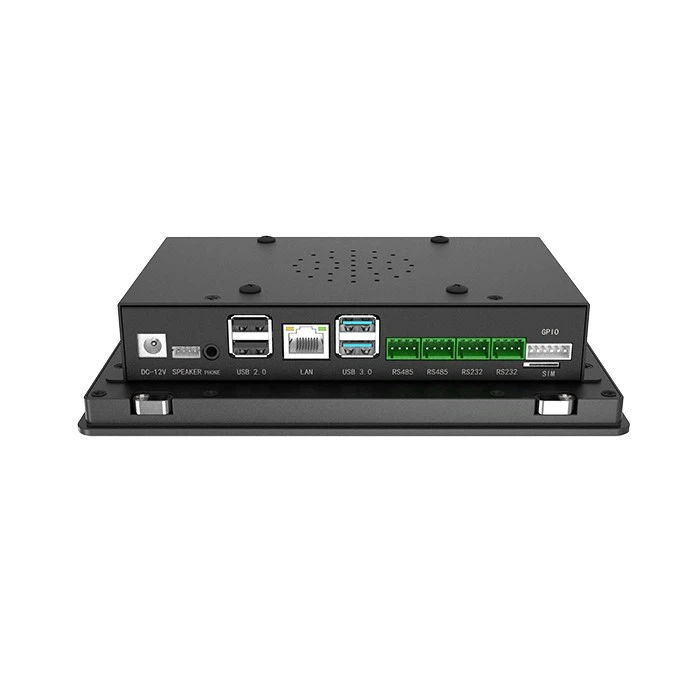
Interface selection and sealing design: Select industrial-grade waterproof and dustproof interfaces (such as waterproof aviation plugs, waterproof USB interfaces). The interface itself must have the corresponding IP protection level. The interface is equipped with a sealing gasket inside, which can form a tight seal when inserted. The installation position of the interface needs to be designed with a sealing groove, and a sealing ring is embedded in it. This forms a dual protection with the sealing structure of the interface itself to prevent water vapor and dust from invading through the connection between the interface and the housing. - Cable protection design: The connecting cables are selected as industrial-grade waterproof and dustproof cables. The outer layer of the cables is made of a wear-resistant and aging-resistant shielding sheath to prevent the sheath from being damaged and allowing contaminants to enter the cable interior. At the connection points between the cables and the interfaces, waterproof connectors or sealant are used for sealing to ensure no gaps; when the cables are routed, they should be avoided from being bent or stretched as much as possible to reduce the stress on the connection points and prevent the seals from loosening. For outdoor or humid environments, the cables can be protected by conduit, further enhancing the waterproof and dustproof performance.
- Interface layout optimization: Interfaces should be concentratedly arranged at the bottom or sides of the module, avoiding placement at the top. This is to prevent rainwater and dust from directly dripping or accumulating at the interface area. A certain distance should be reserved between interfaces to facilitate the installation and maintenance of sealing components, and to avoid interference between interfaces that could lead to sealing failure.
(4) Internal Component Protection Design
Internal components (such as the main control board, touch chip, and display module) are the core of the module. If a small amount of contaminants enter the interior, it is likely to cause component failure. Therefore, in addition to external protection, internal protection design needs to be added to form a dual guarantee:
Internal sealing and isolation: The module adopts a partitioned isolation design within its interior. The main control board, touch chip, and other core electrical components are isolated from the external sealed area, forming an independent sealed cavity. The sealed cavity can be treated with sealant filling, filling the gaps between the components and the housing to prevent a small amount of moisture and dust from coming into contact with the core components; the sealant material must be selected as industrial-grade sealant with high temperature resistance, good aging resistance, and excellent insulation properties, without affecting the heat dissipation and signal transmission of the components. - Internal dust-proof and water-proof auxiliary design: The surface of the core components can be covered with dust-proof and water-proof films to intercept fine dust and water vapor; inside the module, absorbent cotton is set to absorb the small amount of water vapor that seeps in, preventing the accumulation of water vapor inside from causing circuit short-circuit. At the same time, the internal heat dissipation structure is optimized to avoid excessive internal temperature due to poor heat dissipation, accelerating the aging of the sealing parts and indirectly affecting the dust-proof and water-proof effectiveness.
- Component fixation and protection: The core components are equipped with a sturdy fixation structure to prevent displacement of the components and loosening of the connections due to vibration, which could damage the internal sealing structure. The connection terminals of the components are made of waterproof terminals, and the connection points are sealed with sealant to prevent contaminants from invading through the connection points.
III. Key Points for Material Selection in Waterproof and Dustproof Structural Design
The performance of the material directly determines the stability and protective effect of the waterproof and dustproof structure. According to the requirements of the scene, appropriate sealing materials and structural materials should be selected, with a particular focus on the material’s temperature resistance, corrosion resistance, sealing performance and aging resistance: - Selection of sealing materials: The sealing components (sealing rings, sealing adhesives) should primarily use industrial-grade sealing materials such as silicone and fluorosilicone. Silicone sealing rings have excellent elasticity and temperature resistance, and are suitable for most industrial scenarios; fluorosilicone sealing rings have strong corrosion resistance and are suitable for corrosive environments such as those involving chemicals, acids, and alkalis. The sealing adhesive should be selected from room-temperature curing silicone rubber or epoxy potting adhesive, which possess good sealing and insulation properties, and do not affect the performance of the components after curing.
- Selection of structural materials: Apart from the outer shell material, the structural components such as the frame and sealing grooves should use materials with high strength and high processing accuracy to avoid sealing gaps caused by structural deformation. Metal materials need to undergo surface anti-rust and anti-corrosion treatment (such as galvanization, anodization), and engineering plastics should select models with high temperature resistance and anti-aging properties to ensure the structural stability during long-term use.
- Selection of auxiliary materials: The dust-proof net is made of high-density and wear-resistant metal mesh or non-woven fabric to ensure the dust-proof effect without affecting the heat dissipation of the module; the absorbent cotton is selected from materials with high water absorption and resistance to aging, which can effectively absorb the internal moisture; the waterproof breathable valve is chosen as an industrial-grade product with both waterproof and breathable functions, facilitating the discharge of internal moisture in the module and preventing excessive internal pressure from damaging the sealing structure.
IV. Key Points for Testing and Verification of Waterproof and Dustproof Structures
After the waterproof and dustproof structure design is completed, it needs to undergo strict testing to verify that the protective effect meets the design standards and the requirements of industrial scenarios, and to prevent the failure of protection due to design flaws. The core testing items are as follows:
Dust-proof test: According to the designed IP dust-proof level, conduct the corresponding dust-proof test. Place the module in a dust test chamber to simulate the dust environment of an industrial setting. After a certain period of time, check if any dust has entered the module’s interior. At the same time, verify if the touch control and display functions are functioning properly. For example, in the IP6X level dust-proof test, ensure that the module completely prevents dust from entering. - Waterproof Test: According to the designed IP waterproof level, conduct corresponding waterproof tests, including water spray tests and immersion tests, to simulate outdoor rain and workshop moisture scenarios. After the tests, check if water vapor or liquid has infiltrated the module interior and if the core components are functioning normally. For example, in the IP65 level waterproof test, ensure that the module can withstand low-pressure water spray from any direction without any water ingress.
- Environmental Adaptability Test: Simulate temperature variations, vibration shocks, corrosion and other environmental conditions in industrial scenarios. Conduct high and low temperature cycling tests, vibration tests, and corrosion tests to verify the stability of the waterproof and dustproof structure under complex environments, avoiding aging of sealing components due to temperature changes, loosening of seals due to vibration, and damage to the structure due to corrosion.
- Long-term aging test: Place the module in an environment that simulates actual industrial conditions for long-term operation testing. Observe the aging of the waterproof and dustproof structure to verify its long-term protective performance, and ensure that the module can stably perform its protective function throughout its entire life cycle.
V. Conclusion
The waterproof and dustproof structure design of the industrial touch display module is the core for ensuring the stable operation of the module in complex industrial environments. It needs to focus on four key parts: the housing, the panel and frame, the interface, and the internal components. Based on the requirements of the scenarios, it should follow the principles of targetedness, reliability, and compatibility. Through reasonable structural layout, sealing design, and material selection, a comprehensive protection system can be constructed.
During the design process, it is necessary to balance the waterproof and dustproof performance with the touch performance, display effect, and heat dissipation requirements of the module, avoiding the situation where the sole focus on protection leads to the impairment of core functions. At the same time, through strict testing and verification, design flaws can be promptly identified and optimized to ensure that the protection performance meets industrial standards. As industrial scenarios extend to more complex and harsher environments, the waterproof and dustproof structure design needs to be continuously optimized. By combining new sealing materials and structural design concepts, the protection level and long-term stability can be enhanced, providing a guarantee for the reliable operation of industrial touch display modules. At the same time, it can reduce equipment maintenance costs and improve industrial production efficiency.