From Size to Interface: A Comprehensive Guide to All Specifications and Configurations of Senke Industrial Displays
Product knowledge 2026-04-18
The size and interface configuration of industrial displays directly determine whether the equipment can fit the installation space and meet the requirements for external connection and signal transmission. Senke industrial displays cover various size specifications, come with a wide range of interface combinations, and are designed in conjunction with aspects such as installation, protection, and touch control, enabling them to meet the equipment integration and operation needs of different industrial scenarios. This article will provide an in-depth analysis of size specifications, interface configurations, core supporting features, and selection directions, offering a reference for equipment selection.
1. Size Coverage: From Compact Embedded to Large Monitoring Displays, Suitable for Various Installation Spaces
Senke industrial displays offer a wide range of size options, covering from compact embedded scenarios to large central control display scenarios. The size specifications include conventional industrial standard sizes and widescreen sizes, suitable for different cabinet, operation console, and space layout requirements.
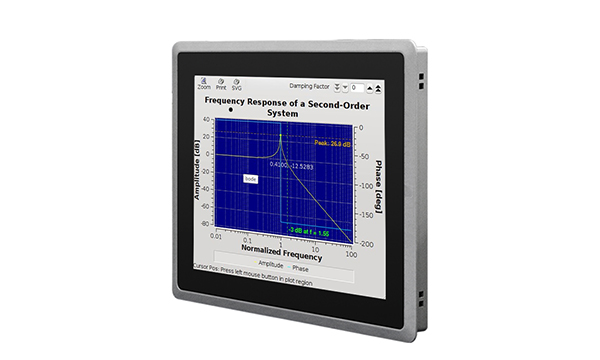
- Small Sizes (7-10.4 inches): Include sizes such as 7 inches, 8 inches, 10.1 inches, and 10.4 inches. These sizes are compact and suitable for embedded installation scenarios with limited space, such as small equipment control panels, instrument and meter display, portable detection equipment, and automated mechanical operation terminals. They can save installation space and meet the needs of basic parameter display and simple touch control operations.
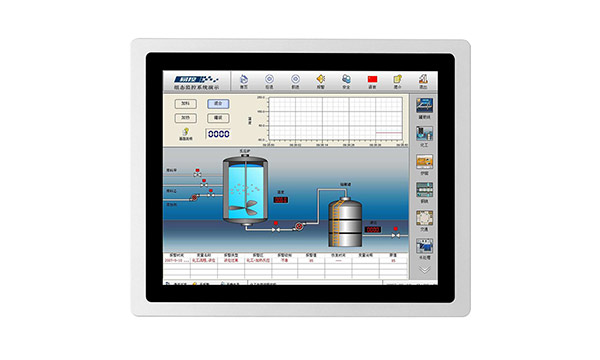
- Medium Sizes (12.1-19 inches): Cover sizes such as 12.1 inches, 13.3 inches, 15 inches, 15.6 inches, 17 inches, and 19 inches. These are commonly used sizes in industrial scenarios. Sizes 12.1-15 inches are suitable for medium-sized equipment cabinets, production line workstations, and warehouse sorting terminals; sizes 17-19 inches are suitable for workshop monitoring consoles, equipment central control units, and main operation interfaces of automated production lines. They can clearly display multiple sets of data and process flow charts, balancing visual range and operational convenience.
- Large Sizes (21.5-27 inches): Include sizes such as 21.5 inches, 24 inches, and 27 inches. These are suitable for scenarios requiring large-scale information display. For example, intelligent factory central control centers, production line monitoring large screens, data monitoring rooms, and large equipment integrated displays, they can fully present multiple equipment statuses, global process flows, and data visualization charts, meeting the needs of multi-person collaborative viewing and global monitoring.
From the perspective of screen aspect ratio, the series products include two mainstream specifications: 4:3 standard screen and 16:9 widescreen. The 4:3 standard screen conforms to the display habit of traditional industrial equipment interfaces, suitable for presenting data tables, parameter lists, and configuration interfaces; the 16:9 widescreen is compatible with high-definition videos, multi-window split-screen display, and visual chart presentation, which can enhance the information carrying capacity.
2. Interface Configuration: Rich signal and peripheral interface, compatible with mainstream industrial equipment
The interface is the core for connecting the industrial display with external devices. The Senke industrial display is equipped with multiple types of interfaces such as video signals, data transmission, power supply, and industrial communication, meeting the needs of signal input, peripheral expansion, and device networking. It is compatible with mainstream industrial peripherals such as PLCs, industrial computers, sensors, and scanning devices.
(1) Video Signal Interface
Supports common video signal interfaces such as VGA, HDMI, and DVI. Some models support dual interface coexistence, compatible with different industrial hosts and signal output devices.
- VGA Interface: Suitable for traditional industrial control devices, old PLC hosts, and conventional industrial computers. Transmits analog video signals, has wide compatibility, and is suitable for most standard industrial display scenarios.
- HDMI Interface: Supports high-definition digital signal transmission, can output 1080P and above resolution images. Compatible with new industrial computers, vision inspection equipment, and high-definition monitoring hosts. The image transmission is more stable, and the color reproduction is better.
- DVI Interface: Digital signal transmission, with strong anti-interference ability. Some models are optional, suitable for industrial scenarios with high requirements for signal stability, such as precision detection and automation control.
(2) Data and Peripheral Interfaces
Equipped with USB, RS232, RS485, etc., to meet the requirements of touch control transmission, peripheral connection, and industrial communication.
- USB Interface: Primarily used for touch signal transmission, and can also be connected to external devices such as mice, keyboards, USB drives, barcode scanners, RFID readers, etc., facilitating data import/export, auxiliary operations, and equipment expansion.
- RS232/RS485 Interface: Industrial standard communication interface, supporting data communication with PLCs, frequency converters, sensors, instruments, etc., suitable for industrial automation control, equipment linkage, data collection, etc., ensuring stable signal transmission.
(III) Power Supply and Network Interface
- Power Supply Interface: Adopting a wide-voltage DC power supply design, it is suitable for the unstable voltage environment in industrial sites, avoiding the impact of voltage fluctuations on equipment operation. Some models support terminal power supply, which is compatible with the wiring standards inside the cabinet.
- RJ45 Network Interface: Some models with integrated touch control and control functions are equipped with this interface. It supports device networking, enabling functions such as remote monitoring, data upload, and system updates, and is suitable for intelligent factories and industrial scenarios of the Internet of Things.
III. Core Supporting Specifications: Matching Dimensions and Interfaces, Enhancing Scene Adaptability
In addition to dimensions and interfaces, the supporting specifications of the Senke industrial display, including the structure, protection, touch control, and installation, work in coordination with the dimensions and interfaces to improve the overall adaptability of the device.
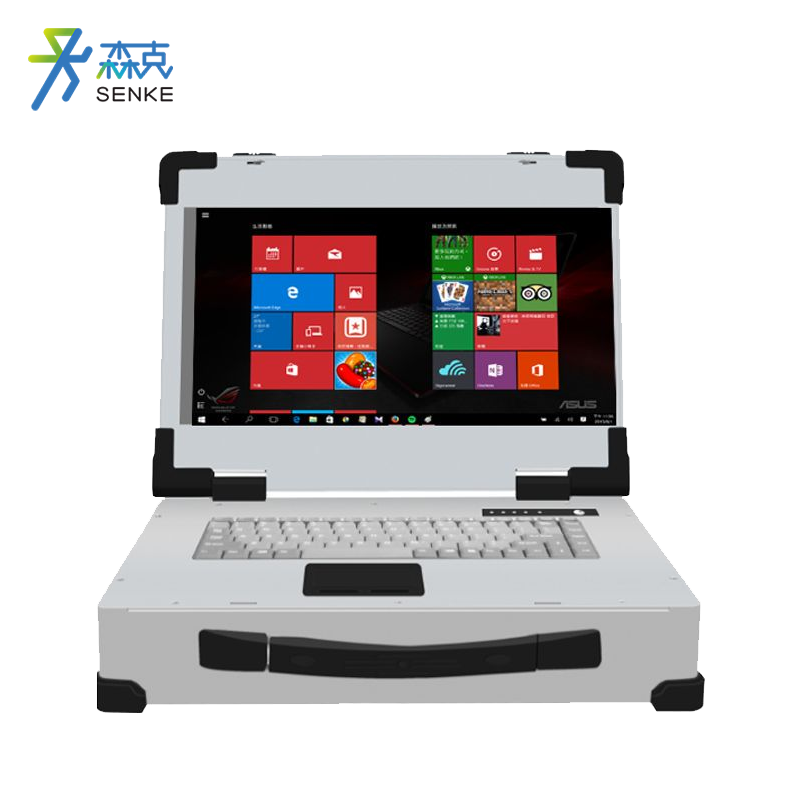
- Body Structure: The all-aluminum body design maintains a compact structure for all sizes. The small size is lightweight and easy to embed, while the large size is stable and resistant to impact, suitable for vibration and collision scenarios during installation and transportation.
- Protection Level: The front panel supports IP65 protection, combined with a sealing structure, suitable for industrial environments with dust, moisture, and oil stains. The protection standards remain consistent for all sizes.
- Touch Type: The entire series supports capacitive touch, and some models offer resistive touch options. Capacitive touch has a sensitive response and supports multi-point operation, suitable for precise control; resistive touch can be operated with gloves and is suitable for oil-stained and dusty scenarios, and can be customized according to the requirements of the scene.
- Installation Method: Supports embedded, wall-mounted, cantilevered, and desktop installation methods. Each size is equipped with standard installation holes, suitable for different cabinets, walls, and operation tables, with high installation flexibility.
IV. Scenario-based Selection Reference: Matching Size and Interfaces According to Requirements
(I) Small Embedded Devices (such as instruments and small machinery)
Recommendation: 7-10.4 inches small size, equipped with VGA + USB basic interfaces.
Adaptation Points: Small size makes them easy to be embedded in narrow spaces, the basic interfaces can meet the requirements for signal input and touch control, the all-aluminum body and protective design are suitable for the complex internal environment of the equipment.
(2) Production Line Workstations, Warehouse Terminals (such as sorting equipment, workstation monitoring)
Recommendation: 12.1-15 inch medium-sized screens, equipped with a combination of HDMI + USB + RS232 interfaces.
Adaptation Points: The moderate size is suitable for workstation operations, the high-definition interface ensures clear images, the industrial serial ports support communication with PLCs and sensors, meeting the requirements for production line data collection and control.
(III) Workshop Central Control, Large Equipment Monitoring
Recommended: 17-19 inch medium-sized, equipped with dual video interfaces + multiple USB ports + RS485 interfaces.
Adaptation Points: Large viewing range, capable of displaying status of multiple sets of equipment, dual video interfaces support dual signal input, multiple interfaces meet the requirements for connecting multiple peripherals, industrial serial ports are compatible with complex equipment linkage control.
(4) Intelligent Factory Central Control Center, Data Visualization Scenario
Recommendation: 21.5 – 27-inch large size, equipped with HDMI + RJ45 + full-function data interfaces.
Adaptation Points: The large size is suitable for global information display, the high-definition interfaces are compatible with visualization charts, the network interfaces support remote data transmission, and all interfaces are compatible with various monitoring and collection devices.
Conclusion
The Senke industrial display is centered around full-size coverage and rich interface configurations, along with corresponding specifications for structure, protection, and installation. This forms a complete product series. When selecting, you can consider factors such as installation space size, signal transmission requirements, peripheral connection types, and scene environment characteristics, and match the corresponding size and interface combination. This enables the display to better adapt to the integration of industrial equipment and on-site operation needs, providing stable hardware support for industrial monitoring, automation control, and data display.