Chinese Industrial Touchscreen Computers: Core Terminals in the Era of Intelligent Manufacturing
Product knowledge 2026-03-31
Intelligent manufacturing is driving the transformation of the manufacturing industry from traditional processes to digitalization, networking, and intelligence. The demand for stable, efficient, and collaborative human-machine interaction terminals in production sites is continuously increasing. Chinese industrial touchscreen computers, with their integrated computing, display, and touch capabilities, have become the key carriers connecting devices, data, and operators, supporting on-site control, data collection, and process collaboration in smart factories.
I. Core Positioning of Industrial Touchscreen Computers
Industrial touchscreen computers in China are distinct from consumer-grade touch devices, designed for industrial scenarios to handle on-site human-machine interaction, data processing, and equipment linkage.
- As the on-site control entry point, they enable parameter configuration, start-stop control, fault alarm, and status visualization.
- As the data collection node, they interface with sensors, PLCs, robots, and AGVs to upload production data in real time.
- As the system interaction terminal, they are compatible with industrial software such as MES, SCADA, and ERP, bridging the management and execution layers.
– With an integrated form factor, they reduce wiring and installation space, and are adaptable to various deployment methods including production lines, cabinets, and operation consoles.
II. Technical Features Adapted to Industrial Scenarios
The industrial environment has strict requirements for equipment reliability and environmental adaptability. Chinese industrial touchscreen computers are designed with typical industrial attributes:
- Environmental Tolerance
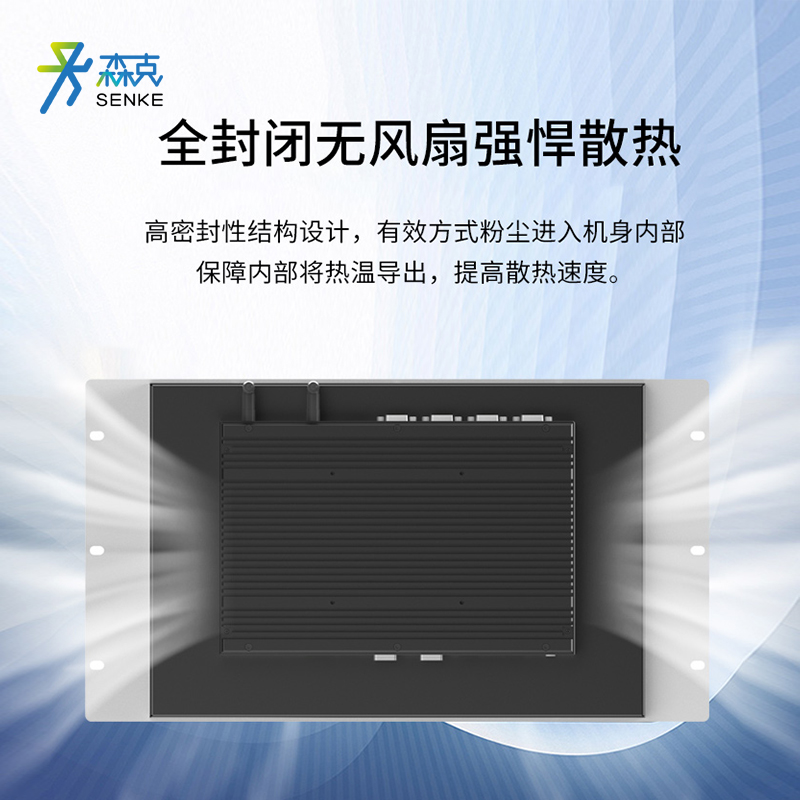
Supports wide-temperature operation, dust-proof and splash-proof design, anti-electromagnetic interference, and can meet 7×24-hour continuous operation, adapting to workshop conditions such as dust, oil stains, and vibration. - Touch and Display Adaptation
Provides resistive touch, capacitive touch, and other solutions, supporting operation with gloves; equipped with high-brightness, anti-glare screens to ensure visibility in strong light. - Interface and System Compatibility
Features rich serial ports, network ports, USB, and GPIO expansions, supporting Windows, Linux, and domestic operating systems, facilitating integration with various industrial protocols and devices. - Flexible Structure and Installation
Supports embedded, wall-mounted, and cantilevered installations; the front panel is designed with an integrated sealed structure to reduce on-site maintenance difficulty.
III. Typical Applications in Intelligent Manufacturing
Industrial touch screen computers in China have been widely adopted throughout the manufacturing process, becoming a fundamental configuration for intelligent production lines:
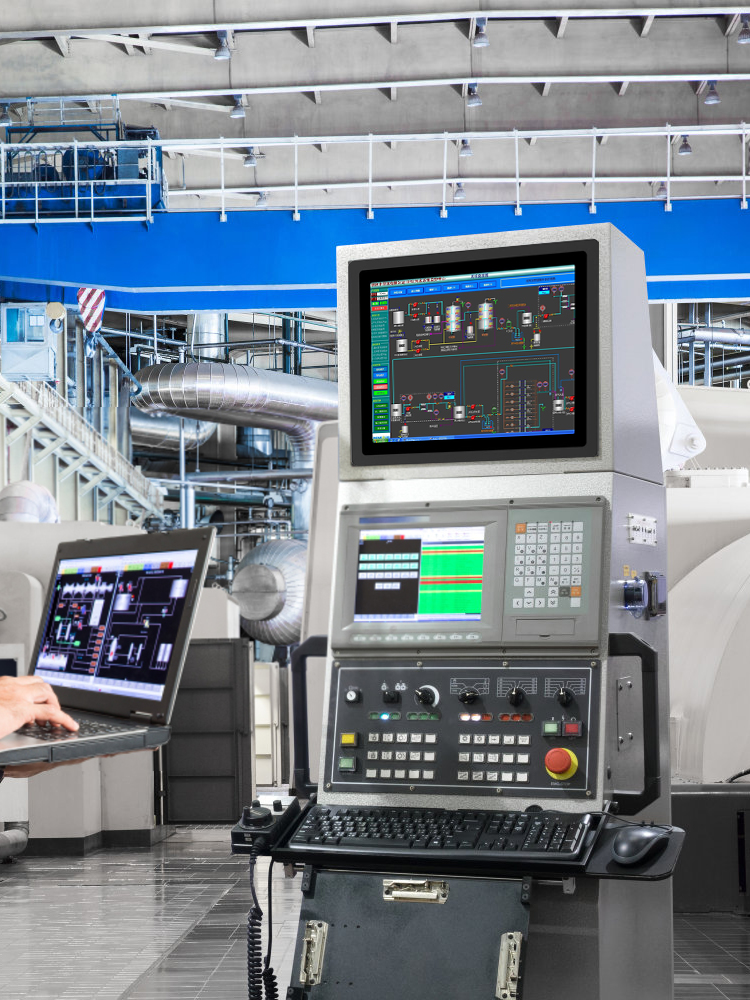
- Automated Line Control: Used in the operation and monitoring of machine tools, injection molding, packaging, and assembly equipment, enhancing process consistency.
- Workshop Data Visualization: Serves as a MES terminal to display production progress, pass rate, energy consumption, and other indicators, assisting on-site decision-making.
- Warehousing and Logistics Management: Cooperates with AGVs and automated storage systems to issue instructions and track the status of sorting, warehousing, and order picking.
- Energy and Equipment Maintenance: Collects operational data from motors, pumps, valves, and power distribution equipment, supporting condition monitoring and preventive maintenance.
– High-End Equipment Integration: Applied in medical equipment, rail transportation, power monitoring, and other fields, undertaking stable interaction and data processing tasks.
IV. Domestic Development and Industrial Value
With the advancement of manufacturing autonomy, Chinese industrial touch screen computers have been continuously improving in terms of supply chain, technical compatibility, and scene services:
- The local supply chain has gradually matured, with enhanced supply capabilities for key components such as processors, screens, and touch control components.
- Deeply adapted to domestic operating systems and industrial software to meet the requirements of information innovation and data security.
- Optimized interaction logic based on local process characteristics to reduce the implementation costs of enterprise digital transformation.
– Promoted the lightweight digitalization of small and medium-sized enterprises, enhancing production management levels with high-performance and cost-effective terminals.
V. Future Development Directions
In line with the deepening of intelligent manufacturing, Chinese industrial touch screen computers will exhibit three major trends:
- Integration of Edge Computing: Incorporating edge computing capabilities to enable local data preprocessing, AI quality inspection, and anomaly detection, thereby reducing the load on the cloud.
- Multi-protocol Interconnection: Enhancing support for industrial Ethernet, 5G, and IoT protocols to improve cross-device collaboration efficiency.
3. Modularization and Low-code Configuration: Standardized hardware combined with flexible configuration software to shorten project implementation cycles and meet the demands of rapid production line changes.
Conclusion
Chinese industrial touchscreen computers serve as a crucial hardware foundation for the implementation of intelligent manufacturing. With their stable and reliable on-site interaction capabilities, they connect physical equipment with digital systems. As technology evolves and application scenarios deepen, these terminals will continue to enhance factory operational efficiency and drive the manufacturing industry towards higher levels of digitalization and intelligence.