Case of intelligent manufacturing implementation: The Senke industrial all-in-one machine empowers the automated production line and helps reduce costs and increase efficiency.
Product knowledge 2026-04-08
During the transformation of intelligent manufacturing, the efficient operation of automated production lines is the key for enterprises to enhance their core competitiveness. Reliable intelligent terminal equipment is an important support for connecting the data links of production lines and optimizing production processes. Many manufacturing enterprises, during the upgrade of their automated production lines, face various challenges such as untimely data collection, poor equipment coordination, high labor costs, and insufficient maintenance efficiency, which affect the improvement of production efficiency. The Senke Industrial All-in-One Machine, relying on stable performance and flexible adaptability, has been applied in multiple automated production line scenarios. Through digital empowerment, it helps enterprises optimize production processes, reduce unnecessary investments, and achieve the goal of cost reduction and efficiency improvement. In some application scenarios, the comprehensive benefits have increased by nearly 30%.
The automated production line of a certain equipment manufacturing enterprise mainly responsible for the processing and assembly of precision components previously had many problems that needed to be solved. Under the traditional production mode, data collection of the production line relied on manual recording, which not only had low efficiency but also was prone to data errors, resulting in a lack of precise basis for production scheduling; at the same time, various equipment in the production line operated independently, lacking unified terminal control, and the troubleshooting of equipment failures was lagging, often leading to equipment shutdown for repair, which affected the continuity of production; moreover, there were many manual operation links, which not only increased labor costs but also could not guarantee the standardization of operations, indirectly affecting the qualification rate of products.
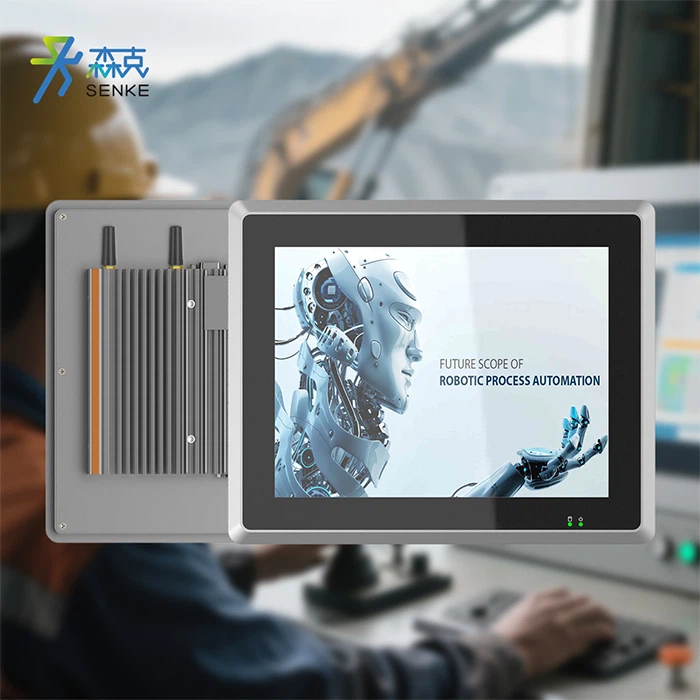
In response to the production line pain points of this enterprise, combined with the core requirements of automated production, Senke customized an industrial all-in-one machine application solution for this production line, deploying the equipment at key positions of the production line to achieve digital control of the entire production process. In the data collection, the Senke Industrial All-in-One Machine seamlessly connects with the PLC, sensors, industrial cameras, etc. of the production line through a complete set of I/O interfaces, real-time collecting data such as equipment operation parameters, production output, processing accuracy, etc., without the need for manual intervention, ensuring the timeliness and accuracy of data collection, providing reliable data support for production scheduling and process optimization, and solving the problems of low efficiency and large errors in manual recording.
In terms of equipment coordination and maintenance, the Senke Industrial All-in-One Machine is equipped with an adapted production management system, achieving centralized control of various equipment in the production line, real-time monitoring of equipment operation status. When equipment malfunctions occur, it can promptly issue warning signals, reminding staff to promptly troubleshoot and shorten downtime. At the same time, the equipment supports remote maintenance functions, allowing staff to remotely view equipment operation data and adjust parameters through the terminal, reducing the need for on-site maintenance and improving maintenance efficiency. This centralized control mode effectively solves the problems of poor equipment coordination and delayed fault troubleshooting, ensuring the continuous and stable operation of the production line.
In terms of operation optimization and cost control, the Senke Industrial All-in-One Machine, by installing an electronic operation instruction system, directly displays production process parameters and operation norms on the terminal screen. Staff can complete standardized operations according to the prompts on the screen, reducing operational errors and improving product qualification rates. At the same time, digital control replaces some manual operation links, reducing the investment of frontline operators and lowering labor costs. In addition, the equipment uses industrial-grade core components and a fully enclosed fanless design, which can adapt to complex environments such as high temperatures and dust in the workshop, ensuring long-term stable operation, reducing equipment replacement and maintenance costs, and further achieving cost savings.
After the introduction of the Senke Industrial All-in-One Machine, the automated production line of this equipment manufacturing enterprise has significantly improved its efficiency after a period of stable operation. The data shows that the data collection efficiency of the production line has increased, the data error rate has significantly decreased, the accuracy of production scheduling has improved significantly; equipment downtime due to malfunctions has been shortened, production continuity has been guaranteed, and production capacity has steadily increased; labor costs and equipment maintenance costs have been effectively reduced, and the product qualification rate has also improved to some extent. The comprehensive cost reduction and efficiency improvement effect is significant, approaching 30%. This on-the-ground case also demonstrates the adaptability and practicality of the Senke Industrial All-in-One Machine in the automated production line scenario.
Similar application cases can be found in various industries such as mechanical manufacturing, electronic processing, and automotive component production. The Senke Industrial All-in-One Machine, with its stable operation performance, flexible interface compatibility, and comprehensive functional support, can precisely meet the various demands of automated production lines, helping enterprises break through the limitations of traditional production models and achieve digitalization, standardization, and efficiency enhancement in the production process. In the process of implementing intelligent manufacturing, the adaptability of terminal equipment directly affects the transformation effect. The Senke Industrial All-in-One Machine, through scenario-based application solutions, empowers the upgrade of enterprises’ automated production lines and helps them achieve the transformation goal of cost reduction and efficiency improvement, providing a reference practice idea for the implementation of intelligent manufacturing in the manufacturing industry.