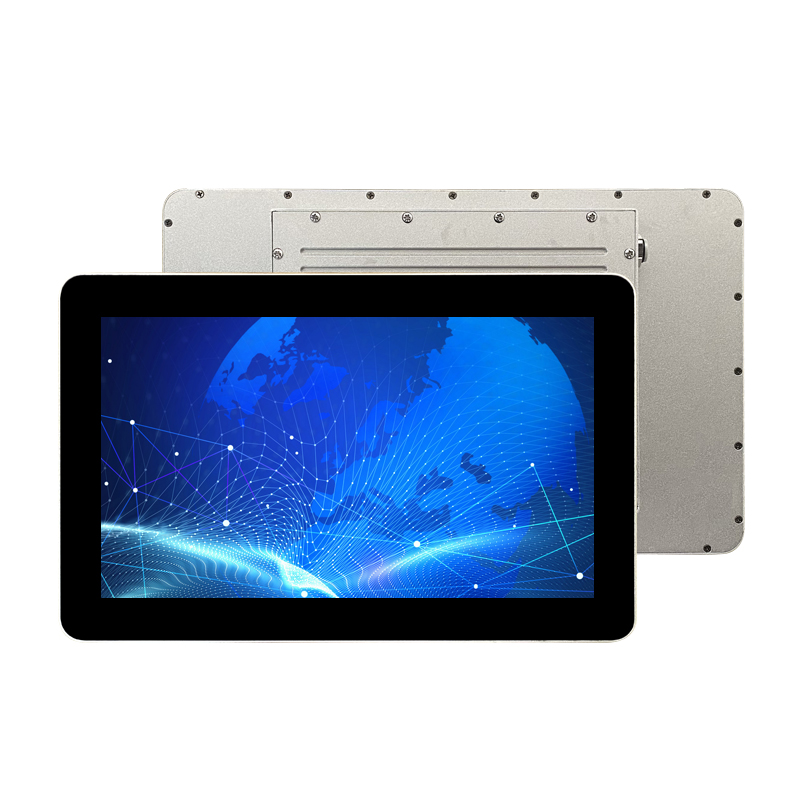
Chinese industrial touchscreen computers: Core interaction terminals in the era of intelligent manufacturing
Product knowledge 2026-03-24
The advancement of intelligent manufacturing has continuously upgraded the human-machine interaction methods in industrial sites. Chinese industrial touchscreen computers, with their characteristics of integration, stability, reliability, and adaptability to complex scenarios, have become the key carriers connecting operators, production equipment, and management systems, playing a fundamental supporting role in digital workshops, automated production lines, and other scenarios.
I. Core Positioning and Value of Industrial Touchscreen Computers
Industrial touchscreen computers are distinct from consumer-grade devices. They are designed for industrial environments and integrate computing, display, and touch interaction functions. Their primary roles include human-machine interaction, data collection, equipment control, and status monitoring.
In the intelligent manufacturing system, they serve as crucial nodes for information flow: on one hand, they convert equipment operation parameters, production progress, energy consumption data, etc., into visual interfaces, facilitating quick access by on-site personnel; on the other hand, they receive operation instructions and pass them on to execution units such as PLCs, servo systems, and robots, ensuring orderly control of the production process.
Relying on standardized interfaces and industrial protocols, such equipment can be connected to systems like MES, SCADA, and ERP, opening up data channels between the field level and management level, reducing information silos, and providing data support for production scheduling, quality traceability, and equipment maintenance and operation.
II. Technical and Design Features Adapted to Industrial Scenarios
- Outstanding Environmental Adaptability
Most products feature reinforced bodies and fanless cooling structures, with capabilities such as wide-temperature operation, vibration resistance, oil-proof, and dust-proof. They can operate continuously and stably in complex environments such as workshops, production lines, and outdoor stations, adapting to on-site conditions in multiple industries. - Convenient Interaction and Operation
Supporting capacitive or resistive touch, it can meet on-site requirements such as operation with gloves on or wet hands. Coupled with a graphical interface, it simplifies the complex operations of traditional button panels, reduces personnel learning costs, and enhances operational efficiency. - Rich Interfaces and Strong Compatibility
Equipped with common interfaces such as Ethernet ports, serial ports, and USB ports, it supports mainstream industrial communication protocols and can be integrated with sensors, CNC machines, visual inspection equipment, etc., meeting the requirements of multi-device networking and data interaction. - Stable and Reliable System
Equipped with an embedded system or industrial-grade operating system, it is ready to use upon startup with a simple background, reducing the probability of malfunctions. It is suitable for 7×24-hour continuous operation in production, ensuring the continuity of the production line.
III. Typical Application Scenarios in Smart Manufacturing
- Production Line Workstation Terminals
Deployed at assembly, processing, and inspection workstations, these terminals are used to display operation instructions, record production data, report abnormal information, and invoke production programs, facilitating flexible production and standardized operations. - Centralized Monitoring of Equipment
As a central monitoring node, it provides real-time display of the operational status, process parameters, and alarm information of multiple devices, supports remote parameter adjustment, reduces the pressure of on-site inspection, and enhances the response speed of operation and maintenance. - Digital Workshop Dashboard
Integrating indicators such as output, yield rate, and equipment utilization rate, it presents the overall production situation through visual charts, assisting management personnel in dynamically adjusting plans and optimizing the allocation of production resources. - Automated production line control
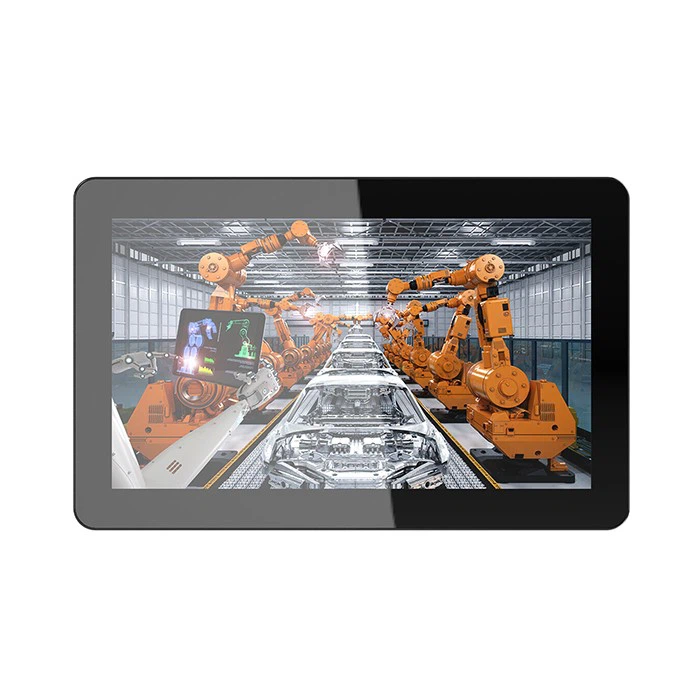
In coordination with robotic arms, conveyor belts, and inspection instruments, it realizes the automated control of the process, reduces manual intervention, and enhances production accuracy and consistency.
IV. Domestic Development and Industry Trends
With the advancement of intelligent manufacturing policies and the improvement of the supply chain, Chinese industrial touch screen computers have been continuously making progress in hardware design, system adaptation, and scenario solutions. The products range from small to large sizes, capable of meeting the customized demands of various industries.
In the future, with the integration of edge computing, the Internet of Things (IoT), and artificial intelligence (AI) technologies, industrial touch screen computers will evolve towards higher computing power, lower power consumption, and more intelligent interaction. This will further enhance local data processing capabilities and device collaboration efficiency, providing more solid hardware support for the digitalization and lean operation of factories.
V. Conclusion
As the core interactive terminal of intelligent manufacturing, industrial touch screen computers in China, with their stable, practical and highly adaptable features, have been deeply integrated into all aspects of production. They not only optimize the human-machine collaboration mode but also provide a fundamental carrier for data-driven production management. In the process of manufacturing transformation and upgrading, they continue to play a significant foundational role.