Domestication adaptation + All-scenario customization: The technological breakthrough path of Senke industrial tablet computers
Product knowledge 2026-04-03
The deepening of industrial digital transformation not only imposes higher requirements on the stability and compatibility of industrial tablet computers, but also drives the domestic industrial hardware towards the direction of autonomy and scenario adaptation. Under the dual waves of domestication substitution and industrial upgrading, industrial tablet computers, as the core terminal connecting devices, data, and management systems, their domestication adaptation capabilities and scene customization levels have become the key for enterprises to establish a foothold in the industry. Senke, based on industrial scene requirements, takes domestication adaptation as the foundation and all-scenario customization as the breakthrough point, has embarked on a technological development path that is tailored to the actual industry and combines practicality and innovation.
With the continuous advancement of the domestication information security strategy, the demand for autonomous control of hardware equipment in the industrial field is increasingly prominent. The traditional industrial tablet computers’ reliance on imported chips and systems has become difficult to meet the security requirements and application scenarios of some industries. Domestication adaptation is not a simple hardware replacement, but a full-chain adaptation from core component selection, system optimization to software compatibility. This requires enterprises to have solid R&D capabilities and rich industrial scene experience. Senke focuses on this industry trend and incorporates domestication adaptation into the core direction of product development, gradually building a product system that adapts to domestic hardware and systems.
In terms of core component domestication adaptation, Senke prioritizes the selection of domestic chips, motherboards, and other core components that have been verified in industrial scenarios. These components have already met the usage requirements of most industrial scenarios in terms of performance stability and environmental adaptability, and also have the advantages of controllable supply chain and convenient maintenance. Unlike simple hardware stacking, Senke invests R&D efforts to conduct targeted debugging and optimization of domestic components, solving compatibility issues among different components, and ensuring the stability and smoothness of the entire machine’s operation. For example, in response to the performance characteristics of domestic processors, optimizing hardware drivers and running algorithms to ensure stable performance in industrial core scenarios such as data collection and multi-task processing.
System-level domestication adaptation is a key link in achieving the autonomy and controllability of industrial tablets. Senke conducts deep adaptation and optimization for mainstream domestic operating systems, including the Keryn system, UOS of Suning, etc., to ensure that industrial tablets can run various domestic industrial software, configuration software, and MES systems smoothly, and connect the key nodes of data transmission and interaction. At the same time, it takes into account the compatibility of the system, supporting the flexible switching between domestic systems and traditional general systems to meet the differentiated needs of different enterprises during their digital transformation stages, clearing obstacles for the migration and domestication substitution of the software ecosystem. This full-chain domestication adaptation not only enhances the product’s autonomy and controllability but also reduces the enterprise’s reliance on imported systems and hardware, ensuring the data security and supply chain stability of industrial production.
The diversity and fragmentation of industrial scenarios determine that general-purpose industrial tablet computers cannot meet the individualized needs of all industries. From flexible production lines in electronic manufacturing to harsh sites in energy and chemical industries, from barcode scanning control in smart warehousing to mobile interaction in outdoor operation, different scenarios have different requirements for industrial tablet computers in terms of size, interfaces, protection levels, and functional configurations. All-scenario customization has become an important path for Senke to break through industry homogeneity and meet diverse needs, and is also one of its core directions of technological breakthrough.
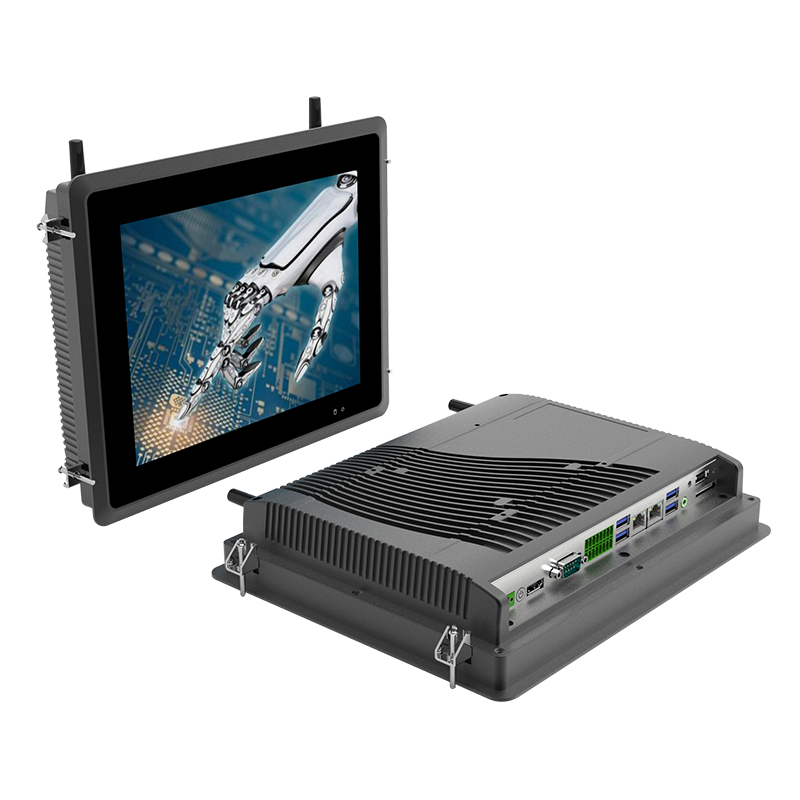
Senke’s all-scenario customization is based on actual industry needs and has formed a complete service process from demand research to solution implementation, from production manufacturing to inspection and delivery. In the early stage of customization, a professional team is arranged to deeply explore different industry scenarios, understand the production processes, equipment connection requirements, environmental parameters, etc. of enterprises, and combine industry characteristics to predict potential needs, issue customized solutions that are in line with reality, balance performance and cost, and avoid redundant configurations. After the plan is determined, based on the modular design concept, the hardware configuration, screen size, interface type and installation method of the products can be flexibly adjusted to adapt to various deployment scenarios such as cabinet embedding, wall mounting, vehicle-mounted, and desktop placement.
During the customized production process, Senke adheres to industrial-grade standards and integrates refined manufacturing and strict quality control throughout the process. According to the special requirements of different scenarios, targeted structural optimization and functional debugging are carried out, such as strengthening the wide temperature and wide voltage resistance, dust-proof and shock-proof performance for outdoor scenarios, optimizing data acquisition accuracy and interface compatibility for precision manufacturing scenarios, and adding data encryption functions for confidential scenarios. Before each customized product leaves the factory, it undergoes full-function testing and stability testing under simulated actual working conditions to ensure that the product can precisely adapt to the target scenario and reduce on-site operation failures.
The integration of domesticization adaptation and full-scenario customization complements each other and progresses collaboratively, jointly forming the technical core competitiveness of Senke industrial tablet computers. Domesticization adaptation provides a solid hardware and system foundation for full-scenario customization, ensuring the autonomy, controllability and stability of customized products; full-scenario customization makes domestic technologies more in line with industry realities, fully leveraging the advantages of domestic hardware and systems in various industrial scenarios, avoiding the problem of technological and demand disconnection. This two-way empowerment model enables Senke’s products to adapt to multiple industries such as equipment manufacturing, electronic production, energy monitoring, and logistics warehousing, achieving an upgrade from general products to scenario-based solutions.
Behind the technological breakthrough is Senke’s profound insight into industrial scene requirements and continuous R&D investment. In the wave of domestic substitution, Senke did not blindly follow the trend but based on its own manufacturing advantages, focused on the polishing and optimization of core technologies, gradually solving technical problems such as compatibility and stability in domesticization adaptation; in the field of full-scenario customization, it always oriented towards user needs, avoiding “fitting to the mold”, through standardized customization processes and refined manufacturing techniques, providing precise-adaptation product solutions for different industries.
As industrial digitalization advances to a deeper level, the scope of domestic substitution will continue to expand, and the demands of industrial scenarios will become more diverse. Senke will continue to deepen the fields of domesticization adaptation and full-scenario customization, continuously optimize core technologies, improve the customization service system, and enhance the adaptability and reliability of products, allowing domestic industrial tablet computers to play a role in more industry scenarios. This technological breakthrough path is not only Senke’s own development choice but also provides a reference for the development of domestic industrial hardware enterprises – only by basing on scenarios and deeply focusing on technology can one move forward steadily in the upgrade wave, providing solid domestic hardware support for China’s industrial digital transformation.