Industrial Visualization Boards: Data Governance and Application Practices in Smart Manufacturing Sites
Product knowledge 2026-03-04
In the construction of smart manufacturing systems, industrial visualization boards serve as crucial carriers for presenting production site data, facilitating process collaboration, and monitoring operational status. They play a key role in breaking down information barriers and supporting management decisions. With the gradual popularization of industrial Internet of Things, edge computing, and data collection technologies in workshop scenarios, the volume of data generated in production processes, including equipment, processes, quality, materials, and personnel, continues to increase. How to standardize the governance of multi-source data, effectively integrate it, and present it reasonably has become a core prerequisite for the stable operation and value realization of industrial visualization boards. This article analyzes the data governance logic and practical application paths of industrial visualization boards, providing reference ideas for the digitalization of production sites.
I. The Positioning of Industrial Visualization Boards in Intelligent Manufacturing
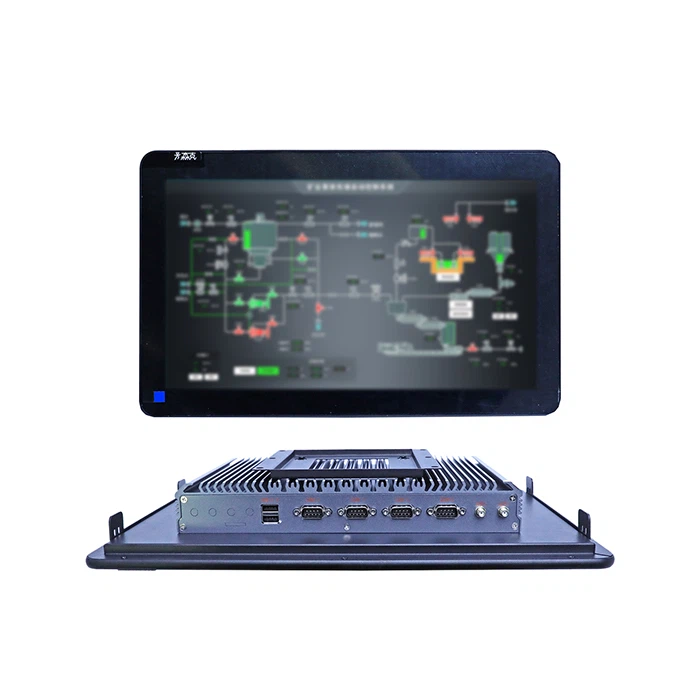
Industrial visualization boards take the production site as the application subject, relying on the workshop network architecture and data collection terminals to centrally display and synchronously update information scattered across various equipment, systems, and workstations. Compared with traditional manual recording, paper announcements, and offline statistics, its core value lies in improving information transmission efficiency, enabling traceability of abnormal states, and quantifying the management process. It is a typical application of the combination of lean production and digital management.
In the architecture of intelligent manufacturing, visual dashboards typically receive data from upper-level systems such as MES, ERP, and WMS, while also connecting to on-site terminals like PLCs, sensors, and RFID devices. This forms a “data collection – data processing – visual presentation – business closed loop” operational chain, providing a unified information interface for production scheduling, quality control, equipment maintenance, and material distribution. It reduces information asymmetry across different positions and enhances the on-site response speed.
II. Core Contents of Data Governance in Smart Manufacturing Sites
Data governance serves as the foundation for achieving accurate, stable, and usable industrial visualization dashboards. Its objective is not merely to collect and display data, but to establish a standardized, reusable, and maintainable data system, which mainly includes the following aspects.
(1) Unified Sorting of Multi-source Data
Data from production sites come from various sources and have different formats and protocols, including equipment operation parameters, switch signals, production counts, process parameters, alarm information, quality inspection results, and batch information of materials. Data governance first requires sorting out data points, clarifying data names, collection frequencies, measurement units, source terminals, associated workstations, and application scenarios, to form a unified data dictionary and avoid issues such as duplicate collection, definition confusion, and inconsistent standards.
(II) Data Collection and Transmission Standards
To ensure the real-time and reliability of the data on the dashboard, it is necessary to select appropriate collection methods and transmission schemes based on the scenario. Stable collection relies on standardized interfaces and protocol adaptation, such as industrial Ethernet, Modbus, and OPC UA, to minimize data packet loss and delay. At the same time, an abnormal collection judgment mechanism should be established to mark signal interruptions, data drift, and communication fluctuations, providing a basis for subsequent data cleaning.
(3) Data Cleaning and Preprocessing
Raw on-site data often contains noise, breakpoints, and outliers, which can lead to misjudgments if displayed directly. Data cleaning mainly includes handling missing values, removing outliers, merging duplicate data, unifying units, and aligning time. Through preprocessing logic at the edge or platform end, the continuity and readability of the dashboard display content are enhanced while ensuring the authenticity of the data.
(4) Data Storage and Permission Management
Based on the importance and usage frequency of the data, a combination of edge caching and platform storage can be adopted, which not only meets the on-site real-time display requirements but also supports historical data query and traceability. At the same time, a data permission system should be established, with viewing scope and operation permissions divided according to job roles. For instance, operators focus on process status, while managers pay attention to overall indicators, ensuring data usage security and process standardization.
III. Typical Application Scenarios of Industrial Visualization Dashboards
Based on data governance, industrial visualization dashboards can be modularly configured according to the type of workshop, production mode, and management focus, adapting to the needs of different industries and scenarios.
(1) Visualization of Production Progress
By integrating planning schedules with actual output data, real-time displays of work order progress, achievement rates, process cycle times, and production line loads are provided. Managers can intuitively grasp the production rhythm, promptly adjust production schedules and resource allocation, reduce waiting times and bottlenecks in process queues, and enhance the overall balance of output.
(II) Equipment Status and Maintenance Monitoring
Display information such as equipment operation status, uptime, duration of fault-induced downtime, and maintenance plans. When equipment malfunctions, the dashboard can simultaneously alert about the issue and its location, enabling maintenance personnel to quickly identify the problem, reduce downtime, and minimize the impact of unplanned outages on production.
(3) Quality Process Control
Visualize the first inspection, in-process inspection, and final inspection data along with defect types, defect workstations, and defect rates. Support statistics by time, process, and product model. Through trend analysis, quality fluctuation risks can be identified in advance, promoting a shift from post-inspection to process control and enhancing product consistency.
(4) Material and Andon System Integration
Display information on material inventory, delivery status, and material shortage alerts. Integrate with the Andon system to enable callouts, responses, and closed-loop records. When material shortages, equipment failures, or quality issues occur on-site, relevant personnel can respond quickly, forming a standardized problem-solving process and enhancing on-site collaboration efficiency.
IV. Key Points for the Implementation of Industrial Visualization Dashboards
The value of industrial visualization dashboards is realized through reasonable planning and steady implementation, rather than relying solely on the deployment of hardware and software.
- Focus on on-site demands: Prioritize designing display content around production pain points, avoid redundant functions, and ensure a simple interface and clear information hierarchy to facilitate quick understanding and use by front-line personnel.
- Emphasize data accuracy: Standardize data collection and governance processes from the source, establish a data verification mechanism, and regularly review and optimize data accuracy, collection frequency, and display effects.
- Strengthen process adaptation: Integrate the dashboard function with existing production management systems and operation processes, promote the linkage between information display and business actions, and form a sustainable management model.
- Balance scalability and compatibility: Select solutions with protocol adaptation capabilities and modular expansion capabilities to support subsequent production line renovations, product upgrades, and system integration needs.
V. Conclusion
Industrial visualization boards are important tools for on-site management in intelligent manufacturing. Their core competitiveness stems from standardized data governance and practical application design. During the advancement of intelligent manufacturing, enterprises can, in light of their own production characteristics, establish a complete system from data collection, governance, presentation to business closed-loop, enabling visualization boards to truly serve the improvement of production efficiency, process controllability and management optimization, and provide stable and reliable on-site support for the digital transformation of the manufacturing industry.