China Industrial Display Company Overview: Quality Manufacturers and Selection Guide
Product knowledge 2026-03-27
Industrial displays are the core hardware terminals of intelligent manufacturing and industrial automation, performing key functions such as data visualization, human-computer interaction, and equipment monitoring. With the acceleration of domestic industrial digital transformation, Chinese industrial display companies have continuously made breakthroughs in technological research and development, product adaptation, and scenario implementation, forming an industrial landscape that covers different demand levels. This article focuses on domestic high-quality industrial display manufacturers, specifically analyzing the products and technical advantages of Senke, and providing practical selection references to help enterprises accurately match industrial display equipment.
1. Market Landscape and Overview of Quality Manufacturers in China’s Industrial Display Industry
The domestic industrial display industry has developed into a diversified competitive situation. There are both established enterprises that have been deeply involved in the industrial control field for many years, as well as new brands that focus on specific scenarios and technological innovation. Overall, it presents a development trend of “domestic technology for manufacturing, customized scenarios, and specialized services”. From the product layout perspective, manufacturers are mainly divided into three categories: First, upstream enterprises centered on panel supply, leveraging their panel technology advantages to expand industrial display business; second, enterprises that focus on the research and manufacturing of industrial display complete machines, covering all categories such as industrial control displays and industrial touch一体 machines; third, comprehensive service providers that offer “hardware + software + solutions”, suitable for complex scenarios such as intelligent manufacturing and smart factories.
At present, the industrial display companies with strong competitiveness in China include: Vantrol Technology, Huaxian Industrial Control, BOE, Hengyu Wei, Senke, etc. Among them, Senke, as a national high-tech enterprise, has become one of the representative manufacturers in the domestic industrial display field by virtue of its independent R&D capabilities, full-scenario product portfolio and customized service capabilities.
II. Senke: Deeply Engaging in Industrial Display, Creating Stable and Reliable Industrial Control Display Solutions
(I) Company Foundation and R&D Strength
Senke was founded in 2012 and is an industrial display equipment manufacturer that integrates R&D, production, sales, and service. It has subsidiaries in Beijing, Shanghai, Guangzhou, and other places, with nearly 400 employees, among whom the R&D team accounts for 20%. The company has accumulated over 100 core software and hardware patent technologies. It focuses on the industrial display and touch control fields, has established a full-chain R&D system from core components to complete machines, from hardware to systems, and possesses the ability to independently design industrial-grade motherboards and customize touch control solutions, providing technical support for product stability and compatibility.
(2) Core Product Matrix: Covering All Scenarios of Industrial Display Requirements
Sank’s industrial display and industrial control all-in-one machine products, centered around the core requirements of “stability, durability, and adaptability” in industrial sites, have formed a rich product series, capable of meeting the application needs of different working conditions, different sizes, and different functions:
- Fully Enclosed Industrial Touch一体机: Equipped with a fully enclosed cast aluminum body and anti-explosion tempered glass, with a protection level of IP65, featuring waterproof, dustproof, oil-proof, anti-static, and anti-corrosion properties, it supports a wide temperature range from -20°C to 70°C, can operate stably for 24 hours around the clock, and is suitable for factory workshops, outdoor equipment, and harsh working conditions. The size ranges from 7 inches to 27 inches, supports capacitive/resistive multi-point touch, ten-point precise touch response, and is compatible with various configuration software and industrial systems.
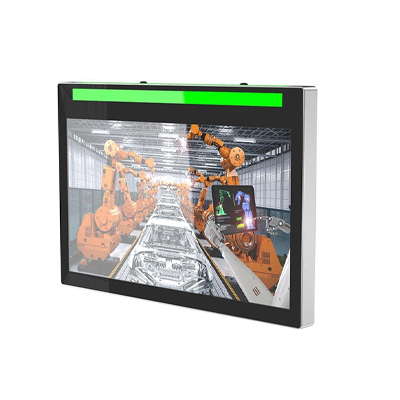
- Embedded/Frame-type Industrial Display: Specifically designed for cabinet integration and equipment embedding, it adopts an all-aluminum body structure, with anti-vibration and anti-interference capabilities, supports various installation methods such as embedding, wall mounting, and desktop, suitable for automated production lines, CNC equipment, power monitoring, etc., and can be paired with low-power processors to meet edge computing and data collection requirements.
- Waterproof Industrial Display Equipment: Made of 304 stainless steel, interfaces equipped with waterproof adapters, enhancing waterproof and dustproof performance, suitable for industries with high cleanliness and corrosion resistance requirements such as food processing, pharmaceutical production, and chemical production, preventing liquid and dust from entering and affecting equipment operation.
- Mini-BOX Embedded Industrial Host: Fanless compact design, approximately 15 cm in length, supports multi-port configurations such as dual networks and dual serial ports, suitable for small spaces and mobile devices, can be quickly deployed, and meets the requirements of lightweight industrial display and data processing.
(III) Technical Advantages: Establishing a Solid Foundation for Industrial Display Stability
- Self-developed Core Hardware: Independently developed industrial-grade motherboards, supporting high-performance processors such as Core I3/I5/I7, along with low-power chips, balance computing power and energy consumption control, ensuring that the equipment does not freeze or crash during long-term operation, and is suitable for high-performance scenarios such as MES systems, HMI human-machine interfaces, and visual inspection.
- Efficient Heat Dissipation Design: Adopting a silent high-conductivity heat dissipation solution, without fan design to reduce failure points, while ensuring the heat dissipation efficiency of the equipment in high-temperature environments, avoiding display abnormalities or hardware damage due to overheating, and suitable for factory high-temperature workshops and other scenarios.
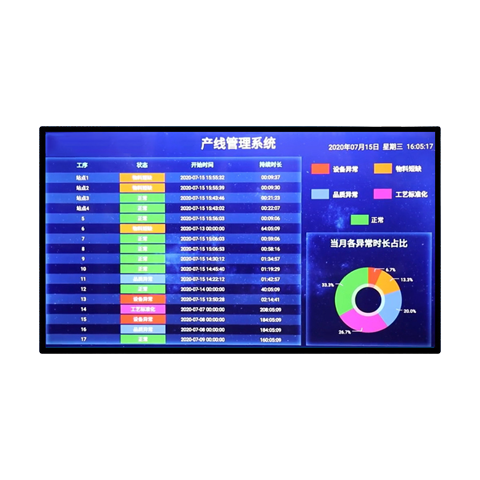
- Multi-scenario Compatibility and Adaptation: The product is equipped with a wireless WIFI module, supports cloud management, can be connected to PLC, AGV, SOP workstations and other industrial equipment, compatible with mainstream industrial software and communication protocols, enabling real-time collection of production data, visual monitoring and command issuance, helping enterprises build digital production lines.
- Customized Service Capability: Can be customized in terms of size, interface, protection level, system configuration, etc., providing exclusive display solutions for industries such as automotive manufacturing, electronic processing, logistics warehousing, and medical imaging, meeting the personalized industrial scene requirements.
(4) Industry Application Implementation
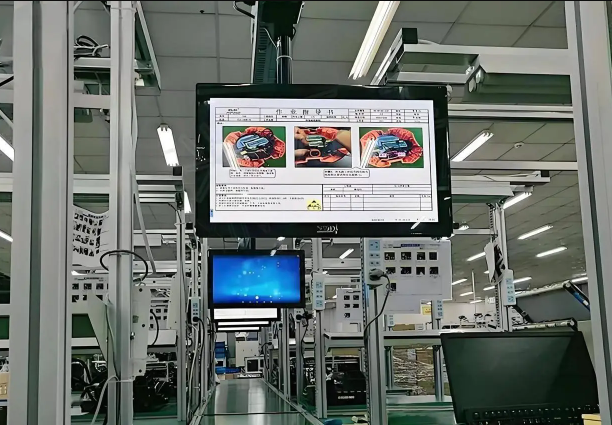
The Senke industrial display has been widely applied in various fields such as intelligent manufacturing, industrial automation, visual inspection, power monitoring, and logistics warehousing: In the electronics manufacturing industry, it serves as the execution terminal for SOP workstations and MES systems, enabling the visualization of production processes and quality control; in the automotive manufacturing sector, it is adapted for intelligent scheduling of production lines and equipment monitoring, and is connected to AGV and PLC systems; in the visual inspection field, it provides high-definition display and precise touch control support for industrial inspection, character recognition, and medical imaging; in the logistics and warehousing scenarios, it cooperates with RFID and barcode devices to achieve visualized information of goods and automatic identification and tracking.
III. Core Guide for Industrial Display Selection
(I) Clarify Scene Requirements and Match Core Parameters
- Environmental Adaptability: Prioritize confirming the temperature, humidity, dust, and liquid conditions of the usage scenario. Select products with a wide temperature range and protection level (IP54 and above are the basic standards for industrial applications). For harsh working conditions, consider equipment with IP65 and above protection and fully enclosed structure.
- Function and Performance: Based on interaction requirements, choose the type of touch screen (capacitive screens are suitable for precise operations, while resistive screens are suitable for scenarios with gloves). According to data processing requirements, match the processor performance and memory configuration. High-definition display and high brightness (≥1000cd/㎡ for outdoor/strong light scenarios) are basic requirements.
- Installation and Integration: Based on the equipment installation space, select installation methods such as embedded, wall-mounted, or rack-mounted. Ensure the compatibility of the equipment with existing cabinets and production lines.
(2) Consider the Core Competence of Manufacturers
- Technical R&D Capabilities: Opt for manufacturers with independent R&D capabilities. Self-developed core components can enhance product stability and post-sale compatibility, avoiding issues related to supply chain dependency that may arise during delivery and maintenance.
- Customization and Service Capacity: For complex industrial scenarios, customized solutions are required. Manufacturers should have the ability to respond quickly and make adjustments as needed; in addition, comprehensive pre-sales technical support and post-sales maintenance services can reduce equipment usage risks.
- Industry Cases and Reputation: Refer to the implementation cases of manufacturers in the same industry to verify the stability and adaptability of the products in actual working conditions. Prioritize brands with rich industry experience.
(III) Sank Selection and Adaptation Suggestions
- For conventional industrial scenarios such as factory workshops and production line monitoring: Select fully enclosed industrial touch display units with IP65 protection and wide temperature operation, suitable for 24-hour continuous operation requirements.
- For special industries such as food, medicine, and chemicals: Prioritize waterproof stainless steel industrial displays, enhancing corrosion resistance and cleaning adaptability.
- For small and micro spaces and mobile device scenarios: Choose mini-BOX embedded industrial control hosts, balancing volume and performance, for rapid deployment of lightweight display solutions.
- For digital production lines and intelligent manufacturing scenarios: Pair with Sank’s self-developed motherboards for industrial control integrated machines, compatible with industrial systems, to achieve data interaction and intelligent control.
IV. Conclusion
The Chinese industrial display industry is gradually achieving a transformation from “following” to “leading” through technological breakthroughs and scenario-based innovations. Domestic manufacturers such as Senke have provided reliable hardware support for industrial digital transformation by deeply researching technologies, refining products, and adapting to scenarios. When selecting equipment, enterprises need to precisely match industrial display devices based on their own working conditions, functional requirements, and service guarantees. Senke, with its all-scenario products, self-developed technologies, and customized services, has become a notable and worthy choice in the field of industrial displays.