Application Practice of Chinese Industrial Touchscreen Computers in Industrial Control Field
Product knowledge 2026-03-24
Industrial control is a crucial aspect for the stable operation and efficient production in the manufacturing industry. With the popularization of automation and digital technologies, traditional control methods have gradually evolved towards integration, visualization, and networking. Chinese industrial touchscreen computers, with their stable reliability, strong adaptability to various environments, and rich interfaces, have been widely applied in industrial control scenarios. From single-machine equipment operation to centralized management of production lines, from data collection to process interconnection, they provide practical hardware support for the optimization of the industrial control system.
1. Basic Requirements for Terminal Devices in Industrial Control Scenarios
The industrial control environment is complex and diverse, and there are clear requirements for the supporting terminal devices. The equipment must have strong anti-interference capabilities and be able to operate continuously in dusty, oily, vibrating, and temperature-differential environments; the interface configuration must meet the connection requirements with industrial control devices such as PLCs, sensors, frequency converters, and servo systems; the system must run stably and support long-term uninterrupted operation to reduce the impact of faults on production; the operation interface must be simple and intuitive, facilitating on-site personnel to quickly master and improve the efficiency of control and debugging.
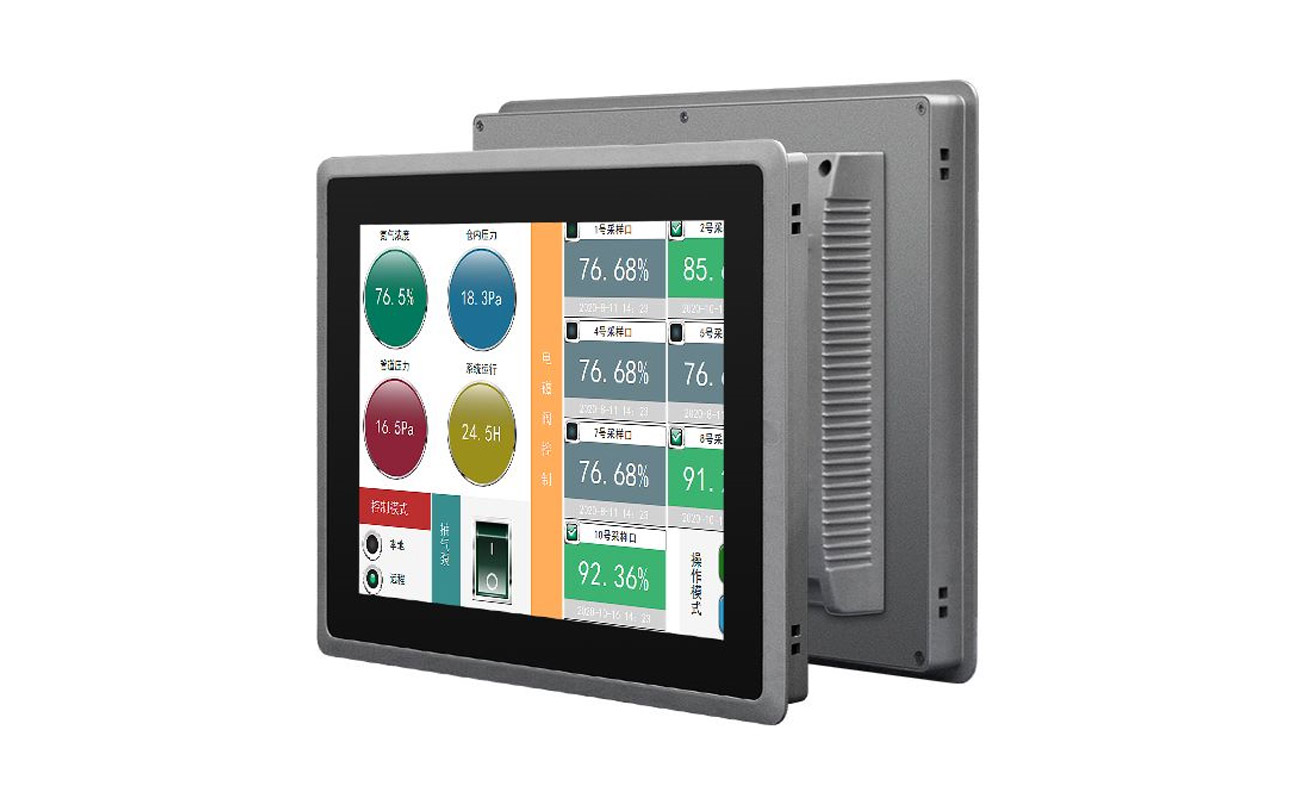
Chinese industrial touch screen computers are designed and iterated based on these practical needs. They continuously optimize in terms of structure, hardware, and software, and gradually adapt to various industrial control scenarios, becoming an important medium for on-site control and data interaction.
2. Core Functions of Industrial Touchscreen Computers in Industrial Control
- Control of On-site Equipment and Parameter Adjustment
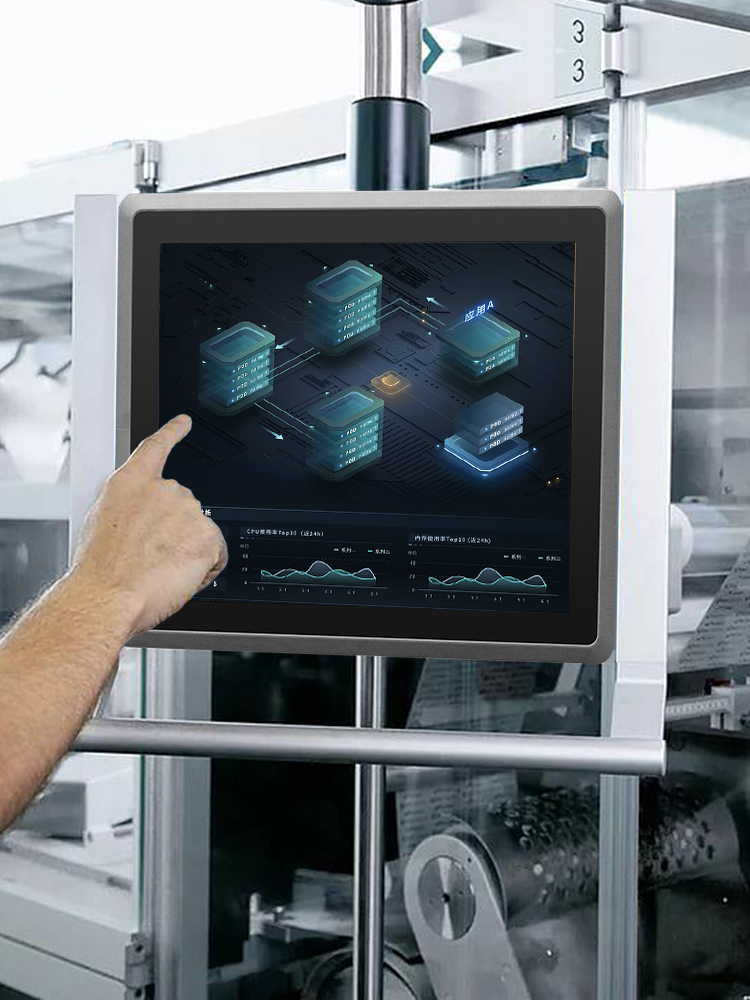
As a human-machine interaction terminal, industrial touchscreen computers can directly control the start and stop of machines, assembly equipment, testing instruments, etc., as well as set parameters and switch programs. Through a visual interface, operators can clearly view the operating status and adjust process parameters in real time, making the equipment operation more in line with production requirements and enhancing the controllability of the production process. - Production Data Collection and Real-time Display
The equipment can be connected to various collection modules to obtain real-time data such as temperature, pressure, rotational speed, flow rate, and output. These data are presented in graphical and numerical forms for intuitive visualization. These data serve as a basis for on-site adjustments and process monitoring, and also accumulate foundational information for subsequent production analysis and quality traceability. - Abnormal State Monitoring and Alarm Notification
By setting predefined thresholds and conducting logical judgments, when the equipment experiences overloading, overheating, communication interruption, or other abnormal conditions, the terminal can promptly issue alarm notifications and record the fault information. This helps the maintenance personnel quickly identify the problem, shorten the processing time, and reduce the impact of abnormal conditions on production. - Multi-device Collaboration and Process Linkage Control
In automated production lines, industrial touch-screen computers enable collaborative control among multiple devices. They can initiate operations in accordance with the production process sequence, such as starting, linking operations, and achieving rhythm matching. This promotes the formation of a continuous and smooth production process for discrete operations, thereby enhancing overall operational efficiency.
III. Application Practices in Typical Industries
1. Equipment Manufacturing and Machine Tool Control
In CNC machines, cutting equipment, and welding equipment, industrial touch-screen computers are commonly used for program invocation, coordinate setting, and processing path preview in control processes. Their stable touch response and anti-vibration design can adapt to the mechanical processing environment, ensuring the continuous and precise operation of the equipment.
2. Automated Assembly and Inspection Line
In industries such as 3C electronics, automotive components, and hardware plastics, the terminal serves as the core control element of the workstation, working in conjunction with automated mechanical arms, conveyor belts, and visual inspection equipment to complete assembly, inspection, and sorting tasks. Through real-time data interaction, it achieves process connection and quality control, thereby enhancing assembly accuracy and product consistency.
3. Energy and Chemical Process Control
In scenarios such as power, HVAC, water treatment, and chemical industries, industrial touch-screen computers are used for centralized monitoring of various instruments and actuators, regulating parameters such as flow, level, and pressure to ensure smooth operation of the production process. The wide temperature operating range and anti-corrosion, dust-proof design of the equipment can well adapt to these continuous production environments.
4. Automation Control of Warehousing and Logistics
In scenarios such as vertical warehouses, sorting systems, and AGV scheduling, the terminals are responsible for tasks like path planning, inventory inquiries, and instruction issuance, enabling the automated control of logistics equipment and enhancing the efficiency of goods turnover while reducing human intervention.
IV. Practical Value Arising from Domestic Application
As the domestic industrial control industry chain gradually matures, Chinese industrial touch screen computers have demonstrated their own advantages in terms of adaptability, delivery cycle, and scenario customization. The products can be adjusted in interfaces, adapted to systems, and customized in functions according to the production line characteristics of domestic enterprises, better meeting the local manufacturing requirements. At the same time, the localized technical support also makes equipment debugging and later maintenance more convenient, helping to reduce the usage and maintenance costs for enterprises.
During the process of promoting the autonomy of industrial control, the collaborative application of domestic terminals, domestic control systems, and industrial software has further enhanced the system’s compatibility and operational stability, providing support for the safe and stable operation of industrial control systems in critical fields.
V. Summary of Development Trends
Driven by the industrial internet and intelligent manufacturing, the application of industrial touch screen computers in industrial control is moving towards higher computing power, stronger interconnection, and greater intelligence. The integration of edge computing capabilities enables terminals to complete some data processing and logical judgments locally; the popularization of remote monitoring and cloud collaboration functions further expands the scope of control and management dimensions.
Overall, China’s industrial touch screen computers have deeply integrated into various industrial control scenarios, providing support for the automation and digitalization upgrade of the manufacturing industry through mature application practices. With continuous technological iteration and deeper exploration of scenarios, these devices will play an even more important role in the field of industrial control.