Chinese Industrial All-in-One Computers: Embedded, Wall-mounted, Desktop Full-Scope Solutions
Product knowledge 2026-03-19
In the fields of intelligent manufacturing, industrial automation, production line upgrades, warehousing and logistics, and various on-site control scenarios, Chinese industrial all-in-one computers have become an important terminal for connecting equipment, data, and human-computer interaction. Unlike traditional commercial computers, industrial all-in-one computers are more flexible in terms of structure, installation, and adaptability. They can be deployed in various ways such as embedded, wall-mounted, and desktop, meeting the usage requirements of different working conditions, spaces, and functions, and providing stable and unified terminal solutions for various industrial scenarios.
1. Embedded Solution: Integration with Racks and Equipment
Embedded installation is a commonly used method in industrial scenarios, mainly targeting closed or semi-closed spaces such as equipment integration, control cabinets, and operation consoles.
Application Features
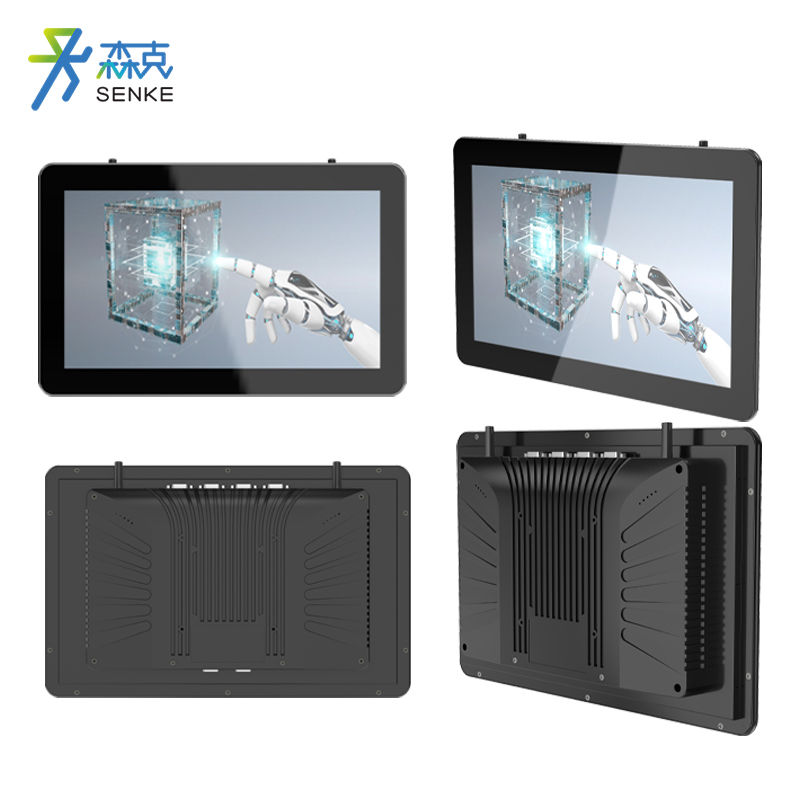
- The body is designed with standardized dimensions, facilitating its integration into cabinets, equipment panels, and operation consoles of automated production lines.
- The front panel is smooth and simple, allowing for installation flush with the surface of the equipment, enhancing overall aesthetics and sealing performance.
- It is suitable for scenarios with limited space and the need for centralized control, such as automated equipment, CNC machines, and testing instruments.
- Adaptation Advantages
- Saves on on-site space, facilitating overall wiring and management.
- Combined with a sealed structure, it can prevent dust and oil from entering, enhancing environmental adaptability.
- Facilitates close connection with devices such as PLC, sensors, and acquisition modules, reducing signal loss.
2. Wall-mounted Solution: Suitable for Deployment on Workstations and Walls
The wall-mounted installation is based on walls, brackets, and columns. It is suitable for scenarios where fixed display, on-site operation, and data viewing are required.
Application Features
- Fixed to the wall or column using a wall-mounted bracket, without occupying floor or countertop space.
- The screen angle can be adjusted according to operational habits, facilitating on-site personnel to view and operate.
- Commonly found in workshop workstations, assembly lines, storage areas, monitoring points beside equipment, etc.
- Adaptation Advantages
- Flexible deployment, allowing for adjustment of position as per the production line.
- Facilitates standing or close-range operation, enhancing work efficiency.
- Suitable for scenarios that require real-time display of production data, process parameters, and equipment status.
3. Desktop Solution: Meeting Fixed Workstations and Office Needs
The desktop solution is more in line with traditional usage patterns and is suitable for relatively organized and well-lit operation rooms, monitoring rooms, quality inspection stations, etc.
- Application Features
- It can be placed on the workbench or operation table with the base, and the usage method is close to the daily habit.
- It is suitable for scenarios that require long-term operation, multitasking, and information entry.
- The environment is relatively tidy. The protection requirements can be flexibly selected according to the actual situation.
- Adaptation Advantages
- Simple deployment, no need for additional modification to the walls or cabinets.
- Convenient to move, can be adjusted to different positions according to the workstations.
- Balances industrial performance with ease of use, suitable for semi-industrial and semi-office scenarios.
4. Core Advantages for All-Scenarios
Regardless of the installation method used, the Chinese industrial all-in-one computer possesses consistent technical characteristics in all-scenario solutions:
- Highly adaptable to the environment
Supports wide temperature operation, resistance to vibration and interference, and can work continuously and stably in complex environments in the workshop. - Rich interface configuration
Equipped with multiple network ports, multiple serial ports, USB interfaces, etc., it can be connected to various industrial devices such as sensors, scanning guns, PLCs, and switches. - Good System Compatibility
Supports mainstream industrial operating systems and can run smoothly various software such as MES, SCADA, data acquisition, and monitoring management. - Long-term stability and reliability
Utilizing industrial-grade components and structural design, it supports continuous operation for a long period, reducing the failure rate and maintenance costs.
V. Scene Selection Suggestions
When enterprises choose the installation method, they can make a comprehensive judgment based on their actual conditions:
- If the space is limited and equipment integration is required: Opt for embedded.
- If there is no countertop at the site and it needs to be fixed to the wall: Choose wall-mounted.
- If there is a standard workbench and the usage frequency is high: Select desktop.
At the same time, in combination with environmental factors such as dust, temperature, and vibration, select the corresponding protection level and hardware configuration to achieve the optimal fit.
Conclusion
The Chinese industrial all-in-one computers, through diversified deployment methods such as embedded, wall-mounted, and desktop, can meet the needs of all scenarios ranging from the production line to monitoring and management. Their flexible structural design, stable hardware performance, and good environmental adaptability can provide unified and reliable terminal support for enterprises’ digital transformation and automation upgrades. In practical applications, selecting models based on the characteristics of the scenarios helps to increase equipment utilization, optimize on-site management, and provide a fundamental guarantee for improving industrial operation efficiency.