Industrial Touchscreen Computer Technology Upgrade: A Leap from Human-Machine Interaction to Intelligent Control and Management
Product knowledge 2026-03-16
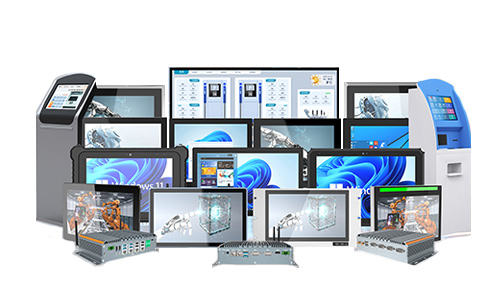
With the deep integration of technologies such as industrial internet, artificial intelligence, and edge computing, industrial touchscreen computers are no longer merely “display + operation” terminals. Instead, they are rapidly upgrading towards intelligence, integration, and modularization, gradually transforming from traditional human-machine interaction tools into intelligent control and management hubs in industrial production, driving the manufacturing industry’s transition from automation to intelligence and digitalization.
The iterative upgrade of touch technology is the core breakthrough for industrial touch screen computers to enhance the interactive experience. In the early days, industrial touch screens were mainly based on resistive touch, which had the advantages of being resistant to pollution and operable with gloves, but had the disadvantages of low operation accuracy, slow response speed, and inability to support multi-touch. They could only meet basic operation requirements. In recent years, projective capacitive (PCAP) touch technology has rapidly gained popularity. With its high light transmittance (up to over 90%), multi-touch support, fast response, and precise operation, it has gradually replaced resistive touch as the market mainstream. It not only improves operational convenience but also supports gesture operation, drag and zoom, and other functions, bringing the industrial operation experience closer to that of consumer electronics. At the same time, flexible touch, infrared touch, and surface acoustic wave touch technologies are constantly being optimized. Flexible touch can be adapted to curved devices, infrared touch is suitable for large-scale scenarios, and surface acoustic wave touch is suitable for high-cleanliness scenarios, meeting the personalized needs of different industries.
The upgrade of hardware configuration provides core support for the intelligence of industrial touch screen computers. The performance of industrial-grade motherboards is constantly improving, featuring low-power, high-stability dedicated processors, along with large-capacity memory and storage, enabling multi-task parallel processing and meeting the computing demands of complex industrial scenarios. The optimization of fanless design not only reduces the impact of dust accumulation on the equipment but also lowers energy consumption and extends the equipment’s service life. Moreover, some high-end models support industrial-grade features such as hot-swapping and redundant power supply, further enhancing the stability and reliability of the equipment’s operation. Additionally, the modular design of hardware is becoming a trend, allowing for flexible combination of interfaces, storage, processors, and other components based on scene requirements, reducing upgrade and maintenance costs, and improving the adaptability of the equipment.
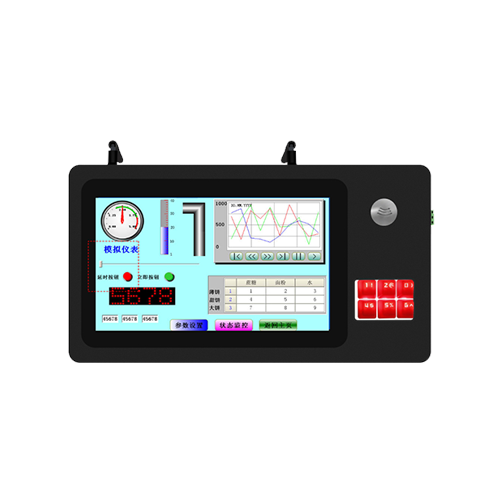
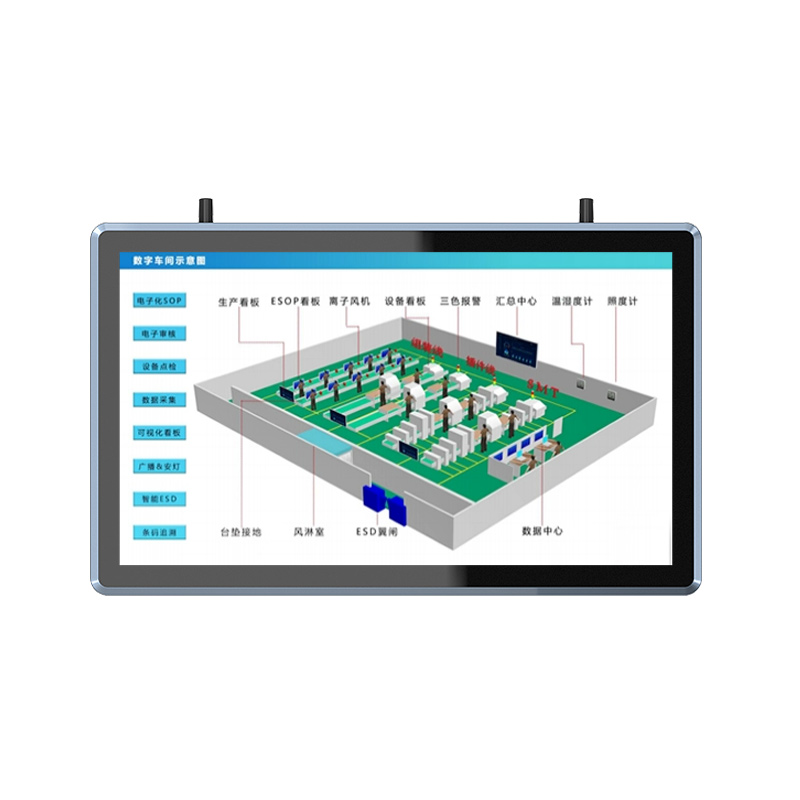
Intelligentization and integration upgrade are the core development directions of industrial touch screen computers. Currently, industrial touch screen computers generally support network connection methods such as Ethernet, 5G, and Wi-Fi, enabling real-time collection, transmission, and analysis of on-site data, seamless integration with industrial management systems such as ERP, MES, and SCADA, and the construction of a complete production information chain. This allows managers to remotely monitor equipment operation status and adjust process parameters, achieving unmanned control. Meanwhile, the integration of AI technology enables industrial touch screen computers to have intelligent diagnosis and self-adaptive adjustment functions, automatically identifying equipment failures and warning of abnormal situations, reducing manual intervention. The improvement of edge computing capabilities enables local data processing, reducing the pressure on cloud transmission and enhancing data processing efficiency, ensuring the real-time and stability of industrial production.
In addition, the upgrade of display technology has also brought better experiences to industrial scenarios. New display technologies such as Mini LED and OLED are gradually applied to industrial touch screen computers. Mini LED backlighting has the advantages of high brightness, high contrast, and low power consumption, which can cope with outdoor strong light scenarios and improve display clarity; OLED display has the characteristics of flexibility and thinness, and is suitable for more special-shaped industrial equipment. At the same time, anti-glare, anti-fingerprint, and high wear-resistant screen processing technologies have further enhanced the applicability of the equipment in industrial scenarios and extended the service life of the screen.