From Standard to Customization: The Evolution and Technological Iteration of Industrial Tablet Computers in China
Product knowledge 2026-03-13
Industrial tablet computers, as the basic computing and interaction terminals in the industrial manufacturing scene, have always evolved their product forms and technical routes in accordance with the demands of industrial scenarios, the maturity of the supply chain, and the depth of digitalization. The development history of China’s industrial tablet computer industry clearly presents an iterative trajectory of moving from standardized complete machines to scenario-specific customization, from general hardware to edge intelligent nodes, and from simple substitution to full-chain autonomous adaptation. This article takes the product evolution as the main line, objectively summarizes the technical upgrade paths and industry development logic, without marketing expressions, no extreme words, and no sensitive content related to advertisements.
1. Initial Stage: Focus on Standardization, Meeting Basic Industrial Replacement Needs
In the early stage of the industry development, industrial tablets were mainly standardized and general-purpose products. Their core function was to replace traditional human-machine interfaces, industrial control computers, and ordinary commercial tablets.
- Product Features
- Dimensions, interfaces, structure, and configuration are relatively fixed, and they are mainly supplied in bulk as ready-made products;
- They focus on meeting basic industrial environment requirements such as wide temperature range, dust-proof, shock-proof, and fanless operation;
- They mainly adopt common X86 or ARM platforms, with functions concentrated on display, control, and data acquisition.
- Technical Focus
- Structural reinforcement and heat dissipation design to ensure stable operation in industrial environments;
- Standardized interfaces, compatible with mainstream industrial protocols and external devices;
- Cost reduction to improve delivery efficiency and quickly cover basic automation scenarios.
- Industrial Characteristics
- Products are highly homogeneous, with price and supply capacity as the main competitive points;
- Mainly applied in general scenarios such as production line monitoring, equipment HMI, and workshop data display.
This stage addresses the issue of the “functional use” of the industrial environment, laying the foundation for the subsequent popularization in various industries.
II. Growth Phase: Customization Emerges, Meeting Diverse Needs in Multiple Scenarios
As the digitalization of manufacturing progresses, a single standard model is no longer sufficient to handle complex working conditions. The industry has entered a period of rapid development in customization. Companies began to develop products differently based on industry conditions, installation methods, and interface requirements, shifting from “general-purpose” to “special-purpose” products.
- Structure and Form Customization
- Installation methods are diverse: embedded, wall-mounted, cantilevered, desktop, vehicle-mounted, handheld reinforced;
- Appearance and size customization: narrow bezel, ultra-thin structure, irregular structure, high-strength reinforced structure;
- Upgrade of protection level: IP65 and above for dust and water resistance, suitable for high-temperature, high-humidity, dusty, corrosive environments.
- Interface and Function Customization
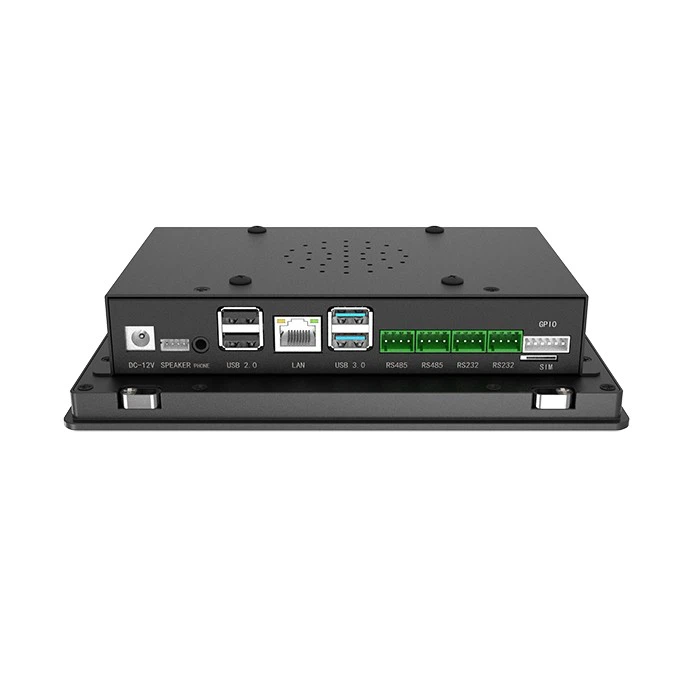
- Serial ports, network ports, GPIO, CAN, analog quantities, etc. can be combined as needed;
- Integration of scanning, RFID, fingerprint, Beidou positioning, dedicated keys, etc. as expansion functions;
- Customization of wide-voltage power supply, power failure protection, surge suppression, isolation design, etc. for electrical characteristics.
- Software and System Customization
- Operating system trimming, startup self-activation, interface solidification, security reinforcement;
- Pre-adaptation of drivers, integration of industrial protocols, optimization of upper software connection;
- Gradual integration of remote management, firmware upgrade, equipment monitoring functions.
The core of this stage is to address the issue of “usability in different scenarios”, and delivery capability, response speed, and engineering experience have become the core competitiveness.
III. Mature Stage: Platformization + Modularization, Enhancing Customization Efficiency and Stability
As the number of customized projects increases, non-standard development leads to high costs, long cycles, and unstable quality. The industry has shifted to the platform architecture + modular expansion model to achieve a balance between standardization and customization.
- Platform Design
- Establish a unified hardware platform and motherboard architecture to ensure long-term supply and stable versions;
- Share core computing, power supply, and cooling solutions on a mature platform to reduce verification costs;
- Unified BOM management to enhance supply chain stability and traceability.
- Modular Expansion
- Interfaces, communications, displays, I/O functions can be flexibly stacked in a modular manner;
- Component modules are modularized to quickly adapt to different sizes and installation methods;
- Software is modularized, supporting on-demand customization and rapid deployment of functions.
- Systematized Quality and Reliability
- Establish standardized testing processes for high and low temperatures, vibration, drop, humidity, EMC, etc.;
- Long-term aging tests and reliability verification have become standard procedures;
- Product life cycle management is standardized, supporting continuous supply for many years and spare parts services.
During this stage, we achieved large-scale customization with high quality, high efficiency and low cost, which enhanced the comprehensive competitiveness of domestic brands.
IV. Current Iteration: Transition from Interactive Terminal to Edge Intelligent Node
As the industrial manufacturing and industrial internet enter the deepening stage, industrial tablet computers are no longer merely display and control terminals; instead, they have evolved into edge computing nodes, intelligent sensing nodes, and data hub nodes.
- Computational Power Upgrade and Edge Computing Integration
- Equipped with higher computational power processors, supporting local data processing and lightweight inference;
- Reducing reliance on the cloud, lowering latency, and enhancing on-site autonomy capabilities.
- Intelligent Sensing and AI Integration
- Supporting machine vision, defect detection, anomaly monitoring, and personnel behavior recognition functions;
- Collaborating with sensors, cameras, LiDARs, etc., to achieve end-side intelligence.
- Interconnection and Protocol Deepening
- Compatible with mainstream industrial protocols such as Profinet, EtherNet/IP, Modbus TCP, and OPC UA;
- Supporting high-speed communication such as 5G and Wi-Fi 6, enabling full data connection from devices to production lines to the cloud.
- Deep Adaptation to Domestication
- Complete stack adaptation of domestic CPUs, operating systems, storage, and firmware is gradually maturing;
- Evolving from availability to stability, reliability, and high performance, meeting the requirements for autonomous control in critical scenarios.
5. Main Lines of Technological Iteration: Environment, Reliability, Intelligence, Ecology
Looking at the evolution of industrial tablet computers in China, technological iterations have been carried out along four main lines:
- Environmental adaptability continuously improves
From basic wide-temperature reinforcement to special environmental adaptations such as high temperature, high humidity, high corrosion, explosion-proof, and safety integrity. - Reliability and stability are continuously strengthened
Fanless design, isolation protection, long-life components, strict testing, and long-term supply have become industry consensus. - From hardware definition to scenario definition
Shift from “selling standard hardware” to “providing industry solutions”, deeply aligning with processes and business procedures. - Ecosystem shifts from closed to open collaboration
Form an adaptive ecosystem with industrial software, PLCs, cloud platforms, AI algorithms, and equipment manufacturers to enhance overall implementation efficiency.
VI. Future Trends: Standardized Base + Deep Customization + Intelligent Evolution
In the future, Chinese industrial tablet computers will follow a three-tier evolution pattern:
- Bottom-level platform standardization: Unified specifications for core computing, hardware architecture, and testing certification;
- Middle-level functional modularization: Flexible configuration of interfaces, communication, sensing, and I/O;
- Top-level scenario deep customization: Provide highly customized solutions for industries such as new energy, semiconductors, rail transit, mining, ports, and special equipment.
At the same time, edge intelligence, low power consumption, domestication, and full lifecycle services will become the core directions of technological iteration.
Conclusion
The transformation of Chinese industrial tablet computers from standard to customized is essentially the result of the joint driving force of upgrade in industrial demands, maturity of supply chain, and accumulation of technical capabilities. The product form has evolved from a single general-purpose hardware to a flexible customizable, stable and reliable, and edge-intelligent industrial terminal. In the future, with the continuous advancement of new industrialization, the industry will continue to deepen iterations in the directions of reliability, customization, intelligence, and domestication, becoming an indispensable basic hardware support in the digital transformation of the manufacturing industry.