A Comprehensive Guide to Industrial LCD Screens: Key Indicators of Wide Temperature Range, High Brightness and Shock Resistance
Product knowledge 2026-03-09
Industrial LCD screens, as the core medium for human-computer interaction in industrial scenarios, their operational stability and adaptability directly affect the normal operation of industrial equipment and automated production lines. Unlike consumer-grade LCD screens, industrial LCD screens need to work for long periods in complex conditions such as high and low temperatures, strong light, and vibration. Wide temperature range, high brightness, and shock resistance are their core performance indicators, which directly determine whether the product can be adapted to various industrial scenarios and are also the key features that distinguish industrial-grade from consumer-grade LCD screens. This article will comprehensively analyze these three key indicators from four dimensions: indicator definition, technical principle, adaptation scenarios, and determination criteria. This will help industry practitioners and related learners clearly understand the core performance logic of industrial LCD screens and avoid cognitive misunderstandings.
The complexity and diversity of industrial scenarios determine that industrial LCD screens cannot follow the performance standards of consumer-grade products. Consumer-grade LCD screens are mostly suitable for indoor mild environments and have lower requirements for temperature, brightness, and vibration resistance. However, in industrial scenarios, extreme temperatures, strong light exposure, and equipment vibration are common issues, which force industrial LCD screens to make special optimizations in core indicators. The three indicators of wide temperature range, high brightness, and shock resistance do not exist independently but work together to ensure the stable operation of industrial LCD screens in complex conditions, providing reliable support for data display and operation control in industrial production.
- Wide Temperature Range Indicator: The Core Guarantee for Adapting to Extreme Environments
(1) Definition of Indicators
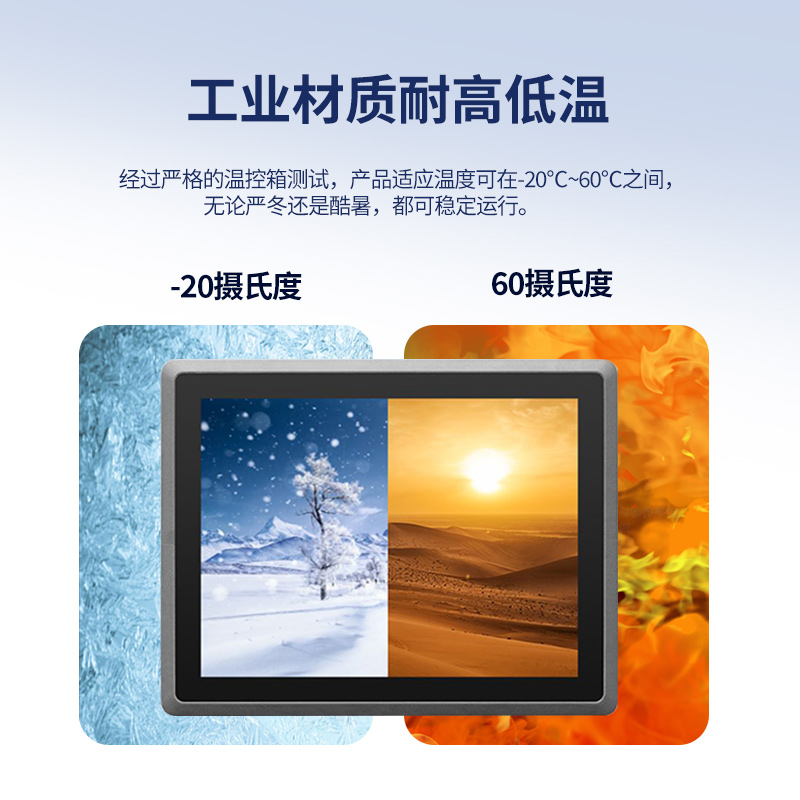
The wide temperature range refers to the temperature range within which an industrial LCD screen can operate stably. It is usually divided into two dimensions: working temperature and storage temperature. The core measure is to determine whether the display effect, response speed, and operational stability of the LCD screen meet the industrial usage requirements under different temperature conditions. Different from the conventional working temperature range of 0℃ – 40℃ for consumer-level LCD screens, the wide temperature range of industrial LCD screens needs to be optimized according to the scene requirements. The working temperature range of regular industrial-grade products is mostly -20℃ – 70℃, while custom products for special scenarios can extend to -40℃ – 85℃, and some products for extreme scenarios can even exceed this range.
It is essential to clarify that the core of the wide temperature range specification is “stable operation”, rather than simply “tolerance to temperature” – that is, the LCD screen, within the specified temperature range, must ensure no black screens, flickering screens, residual images, slow response times, etc., that the display brightness, color, resolution remain stable, the driving circuit has no faults, and can meet the requirements of 7×24-hour uninterrupted operation in industrial scenarios.
(II) Technical Principles
The realization of wide-temperature performance for industrial LCD screens is fundamentally dependent on the technical optimization of three core components: the liquid crystal material, the driving circuit, and the backlight module. These three components work together to overcome the limitations imposed by temperature on display performance.
In terms of the selection of liquid crystal materials, industrial liquid crystal screens use specialized wide-temperature liquid crystal materials instead of the conventional ones used in consumer products. The conventional liquid crystal materials will crystallize and have reduced fluidity under low-temperature conditions, resulting in slow screen response and blurry display; under high-temperature conditions, the liquid crystal molecules will become disordered, causing color distortion and brightness reduction. The wide-temperature liquid crystal materials adjust the molecular structure to enhance the fluidity at low temperatures and the stability at high temperatures, ensuring that the molecules maintain normal arrangement under extreme temperatures and guaranteeing stable display effects.
In the design of the driving circuit, the industrial LCD screen adopts industrial-grade driving ICs, optimizes the circuit layout and power supply design to enhance the stability of the circuit under extreme temperatures. The driving IC acts as the “brain” of the LCD screen, responsible for controlling the arrangement of liquid crystal molecules and signal transmission. Industrial-grade driving ICs undergo high-temperature and low-temperature aging tests, enabling stable operation within a wide temperature range and avoiding circuit failures and signal distortions caused by temperature fluctuations. At the same time, by optimizing the power supply circuit, the influence of temperature on the stability of power supply is reduced, ensuring that the LCD screen receives stable voltage support.
In terms of the optimization of backlight modules, industrial LCD screens adopt high-temperature and low-temperature resistant backlight sources (such as industrial-grade LED backlights), replacing the conventional backlights of consumer products. The conventional backlight sources experience significant brightness reduction at low temperatures and are prone to aging and damage at high temperatures. Industrial-grade LED backlights, through material improvement and structural optimization, can maintain stable brightness output within a wide temperature range, while extending the lifespan of the backlight and meeting the long-term operation requirements of industrial scenarios.
(III) Applicable Scenarios and Criteria for Judgment
The application scenarios of the wide temperature range indicators mainly focus on industrial environments with extreme temperatures, including outdoor industrial environments (such as outdoor photovoltaic power stations, railway station platforms), high-temperature environments (such as metallurgical workshops, petrochemical production lines), low-temperature environments (such as outdoor equipment in northern regions, cold chain warehouse monitoring), and environments with large temperature fluctuations (such as industrial equipment in plateau areas). The requirements for the wide temperature range vary in different scenarios. For example, the northern outdoor environment needs to pay special attention to the ability to withstand low temperatures, while metallurgical workshops need to focus on the ability to withstand high temperatures.
The determination of the wide temperature range indicators requires professional environmental simulation tests. The core test items include: low-temperature storage test (placing the product in a set low-temperature environment for a specified period of time, then powering on and testing to display performance), high-temperature storage test (placing the product in a set high-temperature environment for a specified period of time, then powering on and testing to display performance), and high-low temperature cycling test (repeatedly switching the product between high and low temperatures, and testing to display performance and operational stability). During the testing process, if there is no abnormality such as black screen, flickering screen, or ghosting on the LCD screen, and the display brightness, color, and response speed remain stable, it meets the corresponding wide temperature range indicator requirements.
II. Highlighted Indicator: Visual Assurance in Strong Light Environments
(1) Definition of Indicators
The highlight indicator refers to the display brightness of industrial LCD screens, measured in cd/m² (candela per square meter), and it is the core metric for evaluating the clarity and visibility of the displayed content under strong light conditions (such as direct sunlight in outdoor areas or strong light in industrial workshops). The conventional brightness of consumer-grade LCD screens is mostly between 250-350 cd/m², which can only adapt to indoor weak light or normal light environments. Under strong light conditions, it will cause reflection and blurred display, making it impossible to clearly read the content. For industrial LCD screens, the highlight indicator needs to be optimized according to the scene requirements. The conventional outdoor industrial products can have a brightness of over 500 cd/m², and some customized products for strong light scenarios can have a brightness of over 1000 cd/m². Combined with anti-glare coatings, it can achieve clear visibility under sunlight.
It should be noted that the highlighted indicators are not necessarily the higher the better. Instead, they need to match the requirements of the specific scenario – excessively high brightness will increase power consumption, shorten the product’s lifespan, and may cause visual fatigue; excessively low brightness will not be suitable for strong light environments, affecting the operation experience and production efficiency. The core of the high-brightness design for industrial LCD screens is “matching the scenario, considering both power consumption and lifespan”.
(II) Technical Principles
The realization of high-brightness performance of industrial LCD screens mainly relies on the optimization of the backlight module, the design of the optical structure, and the improvement of the display panel. The three aspects work together to enhance brightness while reducing reflections and lowering power consumption.
In terms of the optimization of the backlight module, industrial LCD screens employ multiple groups of LED backlight beads to enhance the intensity of backlight emission. At the same time, the backlight driving circuit is optimized to improve the stability and uniformity of the backlight brightness. Compared with the single group of backlight in consumer-grade LCD screens, the backlight beads of industrial high-brightness products have a greater number, a denser arrangement, and higher luminous efficiency, which can provide more sufficient brightness support. At the same time, through backlight zone control technology, the backlight brightness of different areas can be adjusted according to the intensity of ambient light, balancing visibility and power consumption control.
In terms of optical structure design, industrial LCD screens employ anti-glare coatings and anti-reflective films to reduce the impact of strong light reflection on the display effect. The anti-glare coating can scatter the incident light, preventing strong light from forming mirror-like reflection on the panel surface and reducing the interference of reflection; the anti-reflective film can enhance the light transmittance, allowing the backlight light to be more efficiently transmitted to the display surface, thereby further improving the display clarity and brightness perception. Additionally, some products adopt narrow bezel designs, reducing the obstruction of the bezels to the light, and enhancing the overall viewing area and brightness utilization rate.
In terms of the improvement of display panels, industrial liquid crystal screens adopt high-transparency panels to replace the conventional panels of consumer products. This reduces the loss of light within the panels and enhances the efficiency of brightness output. At the same time, the arrangement of liquid crystal molecules is optimized to increase the light transmittance and color expressiveness, ensuring that the displayed content is clear and the colors are accurate under high-brightness conditions, and avoiding problems such as uneven brightness and color distortion.
(III) Applicable Scenarios and Criteria for Judgment
The applicable scenarios for highlighting indicators mainly focus on industrial environments exposed to strong light, including outdoor industrial settings (such as outdoor surveillance, photovoltaic power station operation screens, rail transit vehicle displays), strong light workshops (such as metallurgy, forging workshops), and outdoor operating equipment (such as construction machinery operation screens). In these scenarios, the light intensity is high, and conventional brightness LCD screens cannot clearly display the content. Therefore, high-brightness design is required to ensure that operators can quickly and accurately read the key information such as equipment operation parameters and production data.
The determination of the highlight indicators mainly involves testing the display clarity and viewing angle under different lighting conditions. The routine test items include: standard brightness test (measuring the brightness values at the center and edges of the panel under standard ambient light to ensure uniform brightness), strong light visibility test (testing the clarity of displayed content in an environment simulating direct sunlight, with no obvious reflection or blurriness), and brightness stability test (testing the brightness decay after long-term high-brightness operation to ensure stable brightness). Generally speaking, in an environment exposed to direct sunlight, one can clearly read the displayed content without any obvious reflection, which meets the requirements of the corresponding highlight indicators.
III. Seismic Resistance Indicators: Stable Assurance in Vibration Environments
(1) Definition of Indicators
The seismic resistance index refers to the ability of an industrial liquid crystal display to withstand vibration and impact. It is a key metric for evaluating whether the display performance and structural integrity of the liquid crystal screen remain stable during the operation, transportation, and installation of industrial equipment. In industrial scenarios, industrial equipment (such as machine tools, robots, and rail transportation equipment) generates continuous vibrations during operation and may be subjected to impacts during transportation. If the liquid crystal screen has insufficient seismic resistance, problems such as screen cracking, abnormal display, loose interfaces, and damage to internal components may occur, which can affect the normal operation of the equipment.
The shock resistance indicators of industrial LCD screens are usually measured by vibration frequency and impact acceleration. The vibration frequency that conventional industrial-grade products can withstand is 10-500Hz, and the impact acceleration is 10-30G (gravitational acceleration). Customized products for special scenarios (such as military and rail transportation) can withstand higher vibration frequencies and impact accelerations. Compared with consumer-grade LCD screens, the shock resistance design of industrial LCD screens pays more attention to structural reinforcement and component protection, ensuring stable operation even in long-term vibration environments.
(II) Technical Principles
The realization of the shock resistance performance of industrial LCD screens mainly relies on the optimization of structural design, the fixation of components and the application of buffering materials. Through multi-dimensional protection, the impact of vibration and shock on the products is reduced.
In terms of structural design, the industrial LCD screen adopts a reinforced metal casing instead of the thin and light plastic casing of consumer products, enhancing the panel’s resistance to pressure and impact. The metal casing can effectively disperse vibration and impact energy, preventing external forces from directly acting on the display panel and internal components. At the same time, an embedded structural design is adopted, closely integrating the LCD screen with the industrial equipment, reducing displacement during vibration and improving overall stability. Additionally, the panel border design is optimized, increasing the thickness and strength of the border to prevent the screen edge from cracking due to vibration and impact.
In terms of component fixation, the internal components of industrial LCD screens (such as driving ICs, backlight modules, and interfaces) are fixed using reinforced methods. Through components like screws, snap fasteners, and buffer pads, the components are securely attached to the outer shell to prevent loosening or detachment during vibration. For example, the driving ICs are fixed with metal brackets, and the interfaces use reinforced connectors to reduce the impact of vibration on signal transmission; the backlight modules are wrapped with buffer pads to prevent damage to the backlight LEDs and uneven brightness caused by vibration.
In terms of the application of cushioning materials, for industrial liquid crystal screens, special cushioning materials (such as silicone and foam) are filled between the shell and the display panel, as well as between the internal components. These materials have excellent elasticity and buffering performance, which can absorb vibration and impact energy, reduce the impact of external forces on the product, and also play an auxiliary role in dust and water protection, thereby further enhancing the stability of the product.
(III) Applicable Scenarios and Criteria for Judgment
The applicable scenarios of the seismic resistance indicators mainly focus on industrial environments with continuous vibration and impact, including machine tools, industrial robots, rail transit equipment, construction machinery, outdoor mobile equipment, etc. For instance, when machine tools are in operation, they generate continuous vibration, and the LCD screen needs to have strong seismic resistance capabilities to prevent display abnormalities caused by vibration; the on-board display of rail transit vehicles needs to withstand the vibration and impact during vehicle operation to ensure long-term stable operation.
The determination of the seismic resistance indicators requires professional vibration and shock tests. The core test items include: random vibration test (simulating the random vibration during the operation of industrial equipment, testing the stability of product operation), sinusoidal vibration test (simulating specific frequency vibrations, testing the structural integrity of the product), and impact test (simulating the impact during transportation and installation, testing the impact resistance of the product). During the testing process, if the LCD screen has no screen cracking, interface loosening, or display abnormalities, and the internal components are not damaged, it meets the corresponding seismic resistance indicator requirements.
IV. Synergistic Relationship of the Three Indicators and Selection Suggestions
(1) Synergistic Relationship
The three key indicators of wide temperature range, high brightness, and shock resistance do not exist independently but rather work together and influence each other, jointly forming the core reliability system of industrial liquid crystal screens. In actual industrial scenarios, multiple complex conditions often coexist simultaneously. For example, the liquid crystal screens in outdoor photovoltaic power stations need to withstand extreme temperatures (wide temperature range), deal with direct sunlight (high brightness), and resist outdoor wind vibration and equipment operation vibration (shock resistance); the liquid crystal screens in metallurgical workshops need to withstand high temperatures (wide temperature range), deal with strong light in the workshop (high brightness), and resist machine tool vibration (shock resistance).
The coordinated optimization of the three key indicators can enhance the comprehensive adaptability of industrial LCD screens, ensuring their long-term stable operation under complex conditions. For instance, the optimization of the wide temperature technology not only improves temperature adaptability but also indirectly enhances the stability of shock resistance and high-brightness performance; the design of the shock-resistant structure not only can withstand vibrations but also protects the backlight module, driving circuit and other components, preventing them from being damaged due to vibrations and thereby ensuring the normal performance of wide temperature and high-brightness features.
(II) Selection Suggestions
The selection of industrial LCD screens mainly involves matching the corresponding wide temperature, high brightness and shock resistance indicators based on the specific application requirements. There is no need to blindly pursue high parameters, as this can lead to cost waste. The specific selection suggestions are as follows: - Define the scene conditions: First, analyze the temperature range, light intensity, and vibration conditions of the industrial scene, and determine the core indicator requirements. For example, outdoor scenes focus on wide temperature and high brightness indicators, machine tools focus on shock resistance indicators, and high-temperature workshops focus on wide temperature indicators.
- Matching of indicator parameters: Based on the specific working conditions of the scenario, select the corresponding product with the appropriate indicator parameters. For instance, for outdoor scenarios in the north, one can choose a product with a working temperature range of -40°C to 70°C, a brightness of over 500 cd/m², and an anti-vibration frequency of 10 to 500 Hz; for regular industrial indoor scenarios, one can select a product with a working temperature range of -20°C to 70°C, a brightness of 350 to 500 cd/m², and standard anti-vibration indicators.
- Pay attention to the test reports: During the selection process, you can request the supplier to provide test reports on the product’s wide temperature range, high brightness, and shock resistance. This will help you confirm that the product’s specifications meet the requirements of the scenarios, and avoid making selections solely based on parameter labels. This ensures that the product’s performance is genuine and reliable.
V. Conclusion
Wide temperature range, high brightness and shock resistance are the three core key indicators for industrial LCD screens, and they directly determine