How to choose an industrial touch screen computer? Parameter comparison of Senke industrial control all-in-one machines
Product knowledge 2026-04-07
In industrial scenarios, the core of selecting an industrial control all-in-one machine (industrial touch screen computer) lies in the matching of parameters with actual needs, rather than merely pursuing the high or low values of parameters. Different industrial scenarios have significant differences in requirements for equipment protection, temperature adaptation, touch control methods, computing power, and interface configuration. Blind selection can lead to equipment that cannot adapt to the working conditions, resource waste, or abnormal operation. Senke industrial control all-in-one machines offer various specifications of products for different industrial scenarios. Their parameter configuration is designed differently based on the scene requirements. This article objectively compares the key parameters of Senke industrial control all-in-one machines based on the core selection dimensions of industrial touch screen computers, providing industry users with reference to avoid parameter selection mistakes.
When choosing an industrial touch screen computer, the first step is to clearly define the selection logic of core parameters – each parameter corresponds to specific scene requirements, and the core parameters mainly include protection level, working temperature, touch control type, core configuration, interface specifications, and installation method. These parameters directly determine the adaptability and operational stability of the equipment. The parameter design of Senke industrial control all-in-one machines is tailored to the pain points of industrial scenarios. Different models have different emphases on key parameters, which can adapt to a wide range of scenarios from ordinary workshops to harsh conditions. The following compares and analyzes the core parameters of its mainstream models.
Protection level is the basic parameter for industrial touch screen computers to adapt to complex scenarios, mainly measuring the dust and water resistance of the equipment, indicated by the IP grade. The first digit represents the dust resistance, and the second digit represents the water resistance. The higher the grade, the better the protection effect. The protection parameters of Senke industrial control all-in-one machines vary among different models. The conventional models have a protection grade of IP54, which can block most dust and splashing water vapor, suitable for ordinary clean industrial workshops; some models adopt a fully enclosed design, with a protection grade of IP65, capable of completely preventing dust and low-pressure water spraying, suitable for mechanical processing, food processing workshops with a lot of dust and water vapor. These models are equipped with dedicated sealing rubber strips and high-strength metal bodies, effectively reducing foreign object intrusion that causes equipment failures. The two protection grades of models can be selected flexibly based on the cleanliness of the scene and the amount of water vapor, without blindly pursuing high protection grades.
The working temperature parameter determines the environmental adaptability range of the equipment. In industrial scenarios, there are common situations of high temperatures, low temperatures, and large temperature differences between day and night. The wide-temperature design can improve the operational stability of the equipment. The working temperature parameters of Senke industrial control all-in-one machines are divided into conventional wide-temperature and extreme wide-temperature categories. The working temperature range of conventional models is mostly -10°C to 50°C, suitable for most indoor industrial scenarios, capable of coping with daily temperature fluctuations; some models suitable for extreme conditions have a working temperature range expanded to -20°C to 60°C. Using wide-temperature core components and reasonable heat dissipation and insulation design, they can adapt to metallurgical workshops, winter operations in northern outdoor areas, cold chain storage and other scenarios, avoiding problems such as inability to start due to low temperatures or stalling due to high temperatures. When choosing, it is necessary to combine the annual temperature range of the scene and select the corresponding wide-temperature parameter model to avoid redundant or insufficient parameters.
The touch control type parameter directly affects the operability adaptability. Considering the differences in the operating environment of industrial scenarios, Senke industrial control all-in-one machines mainly offer three types of models: capacitive touch, resistive touch, and dual touch. Their parameters and applicable scenarios are different. Capacitive touch models have sensitive response, support multi-point touch and gesture operations, suitable for rapid operations in clean environments, such as parameter settings and monitoring switching in electronic manufacturing workshops; resistive touch models rely on pressure sensing, can be adapted to scenarios with gloves and oil stains, have precise positioning, suitable for precise operations and parameter input, such as chemical and mechanical processing workshops. Dual-touch models combine the advantages of both touch types and can switch modes manually or automatically, making them suitable for a wider range of scenarios, such as mixed conditions with both clean operation areas and complex operation areas. There is no superiority or inferiority among the three types of touch models; the core lies in matching the operating environment and requirements.
Core configuration parameters (processor, memory, storage) determine the operating capabilities of the device. The Senke industrial control all-in-one machine provides different configuration combinations based on computing power requirements. In terms of processors, industrial-grade processors are mainly selected, divided into low-power and high-performance categories. Low-power processors are suitable for light-load scenarios such as intelligent warehouse goods inventory; high-performance processors are suitable for multi-tasking and complex data processing scenarios, such as production line centralized monitoring and machine vision-assisted operations. Memory and storage parameters come in various specifications, with memory ranging from 4GB to 8GB and storage from 64GB to 256GB and above. The choice can be made based on the complexity of the running software and data storage volume to avoid system lag due to insufficient memory or waste due to excessive storage. Some models support storage expansion to meet future upgrade needs.
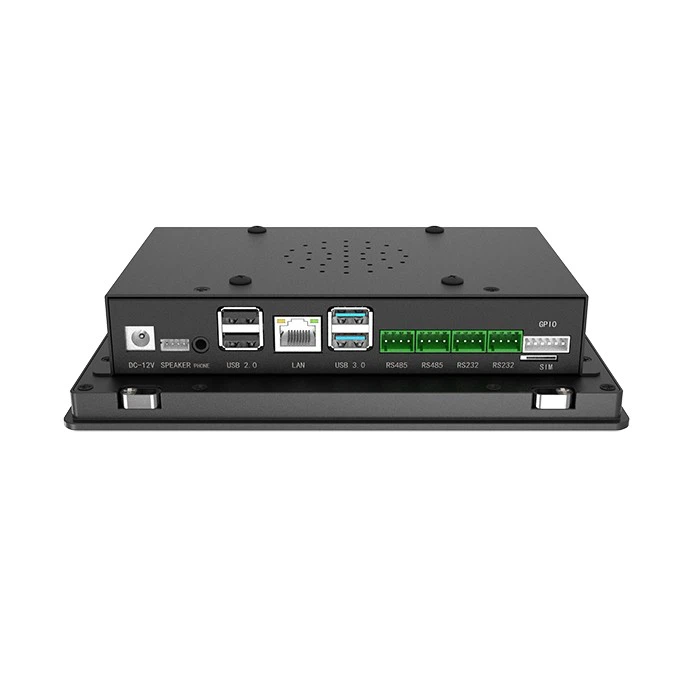
Interface specifications and installation methods are key parameters for device integration and adaptation. The interface parameters of the Senke industrial control all-in-one machine are tailored to the connection requirements of industrial peripherals. Mainstream models are equipped with common industrial interfaces, including USB, RS232/RS485 serial ports, Gigabit network ports, etc. Some models add CAN bus interfaces to adapt to various industrial peripherals such as PLCs, sensors, and printers, achieving integration of data collection and equipment control. The number of interfaces can be selected based on the connection requirements of peripheral devices. Installation methods cover embedded, wall-mounted, and rack-mounted types. Embedded models are suitable for equipment integration installation, saving space; wall-mounted models are suitable for deployment on workshop walls, facilitating operation; rack-mounted models are suitable for centralized deployment in control rooms, facilitating management. Installation method parameters can be selected based on installation space and operational requirements.
By comparing the above parameters, it can be seen that the parameter design of the Senke industrial control all-in-one machine is differentiated based on scenario requirements. The core parameters of different models have their own focuses, and there is no absolute superior parameter combination. The core of purchase is “matching as needed”. In summary, when purchasing industrial touch screen computers, one should first clarify the protection requirements, temperature range, operation mode, computing power requirements, and installation conditions of the scenario, and then compare the parameters accordingly to avoid blindly pursuing high parameters. The various parameter combinations of the Senke industrial control all-in-one machine can cover ordinary industrial scenarios to harsh conditions. Its parameter configuration is in line with industrial scenarios, emphasizing practicality and stability, providing diverse options for users with different needs.