Crafting Screens with Ingenuity: Chinese Industrial Display Companies Empowering Industrial Automation
Product knowledge 2026-03-27
Industrial automation is the core path for the high-quality development of the manufacturing industry. As the core medium for human-machine interaction, industrial displays serve as the crucial bridge connecting physical production equipment with digital management systems. Their stability, adaptability, and accuracy directly affect the operational efficiency, operational safety, and data interaction capabilities of industrial automation lines. Over the years, Chinese industrial display companies have adhered to the concept of “crafting screens with ingenuity”, deeply engaging in technological research and development, refining product quality, and adapting to specific scenarios. They have overcome the homogenization predicament of traditional manufacturing and deeply integrated into the entire process of industrial automation, providing reliable support for the transformation of various industries towards automation, demonstrating the ingenuity of Chinese manufacturing.
The complexity and strictness of industrial automation scenarios place higher demands on industrial displays than ordinary commercial display devices – heat resistance in high-temperature workshops, protection in dusty environments, stability in vibrating conditions, signal reliability in strong electromagnetic interference, and compatibility with automation equipment such as PLC, MES, and AGV, are all core issues that enterprises need to overcome. Chinese industrial display companies have abandoned the development model of “emphasizing output over quality”, integrating ingenuity into every stage of product research and development, production, and testing. They respond to scenario requirements through technological breakthroughs and enhance product resilience through meticulous refinement, making industrial displays truly adaptable to the diverse scenarios of industrial automation and becoming silent and reliable partners on the production lines.
Innate Quality Assurance: Building a Foundation with Strict Standards
Industrial automation lines often require continuous operation 24/7, and any display failure can lead to production line shutdowns, resulting in unnecessary losses. Chinese industrial display companies focus on “long-term stability” as the core, establishing a full-process quality control system, adhering to strict standards at every stage from component selection to product delivery, using ingenuity to build a solid product foundation.
In component selection, the company prioritizes the use of industrial-grade core components, avoiding the performance shortcomings of commercial components, ensuring the durability of the product in extreme environments. For example, the display uses a wide-temperature panel, which can adapt to a temperature range of -30°C to 70°C, capable of coping with the harsh environment near high-temperature kilns and outdoor operation scenarios in cold regions; the touch module selects materials that are highly wear-resistant and resistant to oil stains, supporting glove operation, and adapting to the actual operational needs of workshop workers, avoiding operational inconvenience that affects production efficiency. At the same time, the company conducts strict inspections on each batch of components, eliminating不合格 products, reducing failure risks from the source.
In the production process, the company introduces digital production equipment and refined management models, optimizing production processes and reducing human errors. It adopts a fully enclosed non-fan design, combined with fin-type heat dissipation structure, which not only solves the problem of dust and oil intrusion into the equipment in industrial scenarios but also achieves quiet and efficient heat dissipation, ensuring the long-term stable operation of the equipment; through precise assembly processes, it enhances the shock resistance and impact resistance of the product, capable of withstanding frequent vibrations in industrial scenarios, avoiding display abnormalities caused by equipment shaking.
In the final product testing stage, the company simulates various strict scenarios of industrial automation to fully verify the product. This includes high and low temperature cycling tests, dust and water resistance tests, electromagnetic compatibility tests, vibration and shock tests, etc., ensuring that the product can operate stably under different conditions; at the same time, it repeatedly adjusts the display accuracy, touch sensitivity, and signal compatibility to ensure the accuracy of data transmission and the smoothness of operations, making the product meet the core requirements of industrial automation. This “thousands of hammering and refinement” is a direct manifestation of the ingenuity of Chinese industrial display companies.
Innovation Empowering: Adapting to Automation Scenarios through Technological Innovation As industrial automation progresses towards digitalization and intelligence, traditional industrial displays have failed to meet the new demands such as flexible production, data visualization, and remote control. Chinese industrial display enterprises, with an innovative mindset, focus on technological breakthroughs and promote the transformation of products from “single display” to “intelligent interaction and data linkage”, deeply adapting to the upgrading needs of industrial automation and achieving a leap from “fitting scenarios” to “enabling scenarios”.
In terms of display and touch technology innovation, enterprises continuously optimize product performance and enhance human-computer interaction experience. They promote the adoption of full-lamination technology, eliminating the air layer on the screen, reducing light loss, and improving display clarity and contrast. Even in strong light environments in the workshop, they can clearly present key information such as production data and equipment parameters. They optimize touch control algorithms to achieve flexible adaptation of capacitive multi-point touch and resistive touch, with fast touch response speed, supporting precise operations and batch command input, and adapting to the efficient operation requirements of automated production lines. Some enterprises also introduce high-brightness display technology, with a brightness of over 1000 cd/m², meeting the display requirements of outdoor automated operation scenarios.
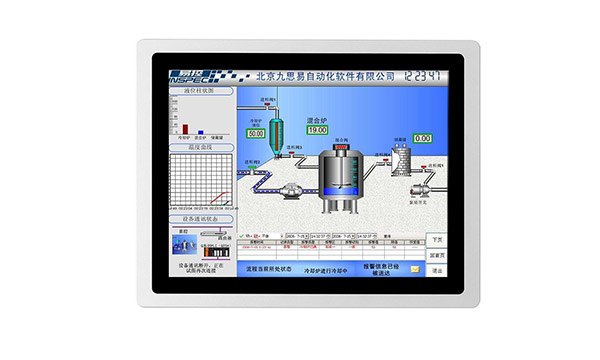
In terms of system compatibility and intelligent upgrading, enterprises focus on the full-chain data interaction requirements of industrial automation, promoting the deep integration of products with automation systems. They independently develop industrial-grade driver solutions, compatible with Windows, Linux, Android, and domestic operating systems, and can seamlessly connect with industrial automation equipment such as PLC, AGV, SOP workstations, and MES systems, enabling real-time collection, visual presentation, and command issuance of production data, allowing operators to control the production line status through the display, and improving control efficiency. At the same time, some enterprises integrate edge computing technology, enabling industrial displays to have local data processing capabilities, reducing reliance on the cloud, and improving data transmission efficiency and security, adapting to the digital control requirements of intelligent factories.
In terms of scenario customization innovation, enterprises deeply explore the differentiated needs of industrial automation in different industries and create exclusive display solutions. For example, for welding workshops in the automotive manufacturing industry, they launch dedicated displays that are resistant to high temperatures and electromagnetic interference; for clean rooms in the food processing industry, they launch waterproof and easy-to-clean stainless steel displays; for flexible production lines in the electronic manufacturing industry, they launch small-sized displays that can be embedded and modularized, adapting to narrow installation spaces; for energy monitoring scenarios, they launch dedicated terminals that can display parameters such as current and voltage in real time, assisting maintenance personnel in quickly locating faults. This “one-size-fits-all” customized service demonstrates the enterprise’s focus on scenarios, allowing industrial displays to truly integrate into the automation production lines of various industries.
Aiming for the future: Protecting automation transformation with full-chain services
The stable operation of industrial automation not only requires reliable products but also requires a complete service support system. Chinese industrial display enterprises adhere to the “service匠心”, building a full-chain service system from pre-sales consultation, in-sales debugging to post-sales operation and maintenance, to support the automation transformation of enterprises, breaking the industry’s predicament of “emphasizing sales but neglecting services”.
In the pre-sales stage, enterprises arrange professional technicians to connect with customers, understand the production scenarios, automation equipment configuration, and display requirements of the customers, providing targeted product selection suggestions to avoid usage problems caused by product mismatch with scenarios. At the same time, they provide solution design services, combining the customer’s production line layout, optimizing the installation method and interface configuration of the display to ensure that the product can be seamlessly integrated into the existing automation system.
In the in-sales stage, enterprises provide on-site installation and debugging services, arranging technicians to guide the installation of the equipment, debug the display parameters and system compatibility, ensuring that the product is installed properly and operates normally. At the same time, simple operation training is provided for the customer’s operators, explaining the usage methods of the products, daily maintenance techniques and common fault handling methods, helping customers quickly get familiar with and use the products.
In the after-sales process, the enterprise establishes a complete operation and maintenance service network, sets up a 24-hour service hotline, and responds promptly to customers’ fault repair requests. For remote areas or complex faults, technicians are arranged to provide on-site maintenance, shortening the fault handling cycle and reducing production line downtime losses caused by equipment failures; at the same time, value-added services such as firmware upgrades and equipment maintenance are provided, and customers are reminded to perform equipment maintenance regularly to extend the product’s service life and ensure the long-term stable operation of industrial automation production lines.
Crafting Dreams: Empowering High-Quality Development of Industrial Automation
From the automation transformation of traditional manufacturing to the comprehensive construction of intelligent factories, Chinese industrial display enterprises use craftsmanship to create screens, with quality and technology providing solid hardware support for the transformation of industrial automation. On intelligent production lines in automotive manufacturing, industrial displays realize the visualization of production line scheduling and equipment monitoring; in flexible production in electronic processing, industrial displays assist in precise control of process parameters; in the scenario of energy monitoring, industrial displays achieve real-time presentation of data and fault warning; in the automated system of logistics and warehousing, industrial displays cooperate with RFID and barcode devices to achieve rapid identification and tracking of goods information. Behind these applications lies the commitment to craftsmanship, pursuit of quality, and persistence in innovation by Chinese industrial display enterprises.
Currently, industrial automation is developing towards a more intelligent, more flexible, and more efficient direction, and the requirements for industrial displays will continue to increase. Chinese industrial display enterprises will continue to uphold the spirit of craftsmanship, delve into technological research and development, polish product quality, optimize service systems, focus on the core needs of industrial automation, promote continuous product and technology upgrades, break through high-end technical barriers, and achieve the leap from “manufacturing” to “intelligent manufacturing”.
Crafting Screens, Empowering Manufacturing. Chinese industrial display enterprises, with the determination of upholding quality as the original intention, being bold in innovation, and serving customers with sincerity, are steadily advancing on the path of empowering the transformation of industrial automation, not only promoting the high-quality development of their own industries, but also injecting lasting power into the transformation of China’s manufacturing automation and intelligence, writing the chapter of craftsmanship in Chinese intelligent manufacturing.